
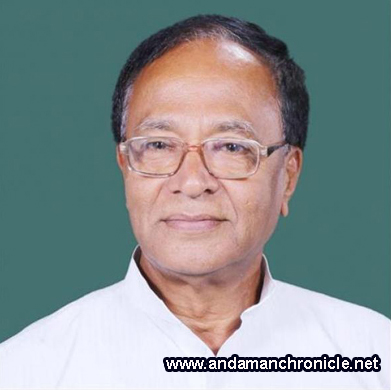
Sri Vijaya Puram, April 8: Shri Bishnu Pada Ray, Hon’ble Member of Parliament, Andaman & Nicobar Islands, has submitted detailed objections and suggestions on the Draft Master Plan for the Great Nicobar Island Development Area, urging the Administration to clearly separate strategic Greenfield project zones from the island’s long-settled revenue villages.
The MP has made it clear that he is not opposing development in Great Nicobar. He has supported the need for a proper planning framework for major strategic infrastructure, trunk services, environmental safeguards, institutional coordination and large project-driven zones. He has stated that for newly conceived development areas, a formal planning instrument is understandable and necessary.
However, Shri Bishnu Pada Ray has strongly objected to applying the same heavy and complex planning architecture to old revenue villages which are already settled and have grown over time through ordinary village life. He has pointed out that these villages are not blank-slate townships, but living habitations with livelihoods rooted in agriculture, fisheries, trading and services.
According to the MP, the present draft risks over-regulating long-settled villages through excessive land-use zoning, subdivision controls, setbacks, parking norms, layout rules and other technical restrictions more suited to new urban extensions than existing village settlements. He has warned that this would be administratively unfair and conceptually unsound.
Shri Bishnu Pada Ray has further stated that the draft, in its present form, appears inconsistent with the Union Territory’s own declared policy of deregulation and compliance reduction. Referring to the policy direction already recommended for Union Territories, he has emphasized that governance should move toward minimal zoning, broad permissibility, mixed use, reduced prior approvals, elimination of redundant NOCs, and the principle that everything should be permitted unless specifically prohibited.
He has observed that instead of simplifying village governance, the present draft creates more classifications, more layers of control, more scrutiny and more authority-based intervention. In his view, this is the opposite of the light-touch and village-sensitive framework that such long-settled habitations require.
The MP has therefore proposed a dual-track approach. He has suggested that the detailed master plan may continue for the new strategic and project-driven zones, but that the old revenue villages should be brought under a simplified village development and regularisation framework with limited zoning, mixed village use by default, a short negative list of hazardous or impermissible activities, easier norms for routine construction, and outcome-based regulation instead of process-heavy approvals.
In his communication, Shri Bishnu Pada Ray has stressed that development must proceed, but it must proceed with administrative realism, policy consistency and fairness to the long-settled residents of Great Nicobar. He has urged the Administration to reconsider the provisions affecting existing revenue villages before finalising the Draft Master Plan.
“Development in Great Nicobar must move forward, and strategic project zones can certainly have a detailed planning framework. But old revenue villages cannot be treated as if they are newly created urban townships. Long-settled residents should not be trapped in an overdesigned and permission-heavy system merely because a large strategic project is coming up in the island”, said MP in his views and suggestions submitted to the Administration.