
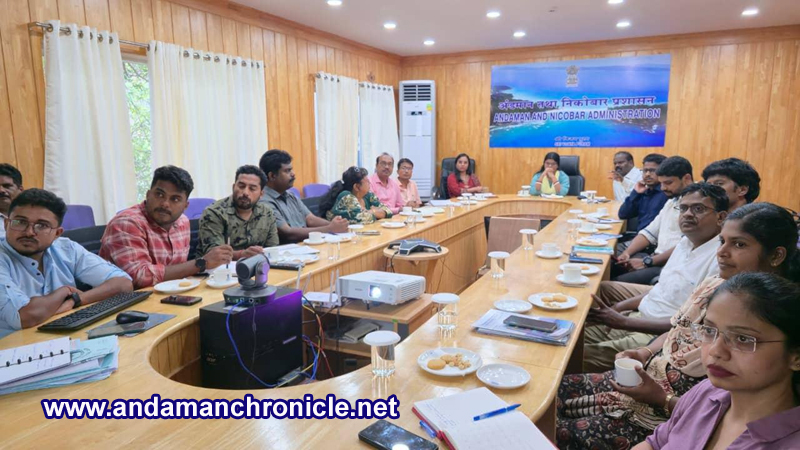
Sri Vijaya Puram, April 22: The Fisheries Science Division of ICAR–Central Island Agricultural Research Institute (CIARI) conducted an interaction meeting with the State Fisheries Department of the Andaman and Nicobar Islands (A&N Islands) on 21st April 2024 at the Secretariat, Sri Vijaya Puram. The meeting aimed to present recent technological advancements and achievements for strengthening lab-to-land transfer and promoting fisheries-based entrepreneurship in the islands.
The meeting was convened by Pallavi Sarkar, Secretary, Fisheries Department, A&N Islands, and organized at the invitation of the State Fisheries Department to explore collaborative pathways for scaling up innovative technologies to farmers and entrepreneurs under field conditions.
Dr M. Muruganandam, Principal Scientist and Head of the Fisheries Science Division (FSD), delivered a presentation highlighting a range of cutting-edge technologies developed and promoted by the institute. These included next-generation biofloc systems, indoor and outdoor crab fattening techniques, freshwater ornamental fish breeding and entrepreneurship, and integrated approaches for disease diagnosis, monitoring, and aquatic animal health management. The economic viability of technologies such as biofloc-based aquaculture and cost-effective feed production systems was also emphasized.
Ms. Pallavi Sarkar expressed keen interest in the technologies presented and stressed the importance of their dissemination through last-mile extension mechanisms and state-led missions. She requested CIARI’s technical support for strengthening tuna clusters, seaweed farming initiatives, and biofloc-based enterprises under schemes such as the Pradhan Mantri Matsya Sampada Yojana and other coastal fisheries development programs.
Dr. Muruganandam also sought support from the State Department for diagnostic research on blood clam (Anadara granosa), which is currently undergoing intensive harvesting and export. He emphasized the need for scientific studies on population dynamics, breeding biology, seasonal abundance, and sustainable harvesting protocols, supported by appropriate legal and policy frameworks.
Highlighting the immense fisheries potential of the islands with approximately 30% of India’s Exclusive Economic Zone (EEZ) and about 26% of its coastline, Dr. Muruganandam called for effective collaborations and convergence of Departments and programs for the common cause. With rich biodiversity, diverse aquatic ecosystems, nearly 70% underutilized fisheries resources, and high annual rainfall (~3300 mm) contributing to significant water resource potential, the region offers unique opportunities for fisheries development.
On the issue of artificial reef deployment, he emphasized the need for careful site selection based on scientific evaluation. He advised balancing the benefits of fish aggregation and livelihood support with existing resource availability, suggesting that awareness generation, market development, and export linkages should precede large-scale reef installations. He also advocated for refined policy guidelines to promote marine ornamental fish collection, breeding, seed production, and entrepreneurship, a sector currently in a dormant stage. He further emphasized that fisheries development must be integrated within the broader framework of environmental sustainability and societal well-being to ensure long-term resilience.
The discussion also highlighted the need to establish a formal Memorandum of Understanding (MoU) between ICAR-CIARI and the State Fisheries Department to facilitate collaboration in training, technology demonstration, and production enhancement for livelihood improvement, food security, and ecosystem conservation.
The CIARI team proposed two priority research projects for financial support from the State Fisheries Department:
1. Assessment of population dynamics of blood clams and zonation to develop science-based policy guidelines for sustainable harvesting and export management.
2. Development of advanced microalgae and live feed-supported breeding, seed production, and farming technologies for blood clams and marine ornamental fish species.
Scientists from CIARI, including Dr Kirubasankar, Sh Karunakaran, Dr Praveen Raj, Sh Chittaranjan Raul, and Dr Jess Maria Wilson, shared insights on ongoing research and development activities. Contributions included experiences from scientific knowledge hubs in Nicobar tribal regions, success stories in ornamental fisheries, disease diagnostics frameworks, biofloc-based P. vannamei shrimp farming, carp seed and feed production systems, and advancements in microalgae production and fisheries digitization.
Ms Jagtap Kalyani, Director of Fisheries, emphasized collaboration with CIARI for scaling up biofloc technology and crab fattening systems. State officials also sought support for renovation and re-establishment of the Fisheries Museum at Sri Vijaya Puram. Participants from North & Middle Andaman and Nicobar districts invited CIARI scientists to provide field-level, science-based solutions to local challenges.
Deliberations also covered production systems, seed supply chains, and distribution strategies to enhance aquaculture productivity and sustainability. Discussions extended to fisheries resource management, emphasizing the need for enabling legal and policy frameworks.
Opportunities were identified in the farming of pearl oysters, green mussels, and diversification into freshwater and brackishwater aquaculture, including species such as Piaractus brachypomus (pacu), Clarias batrachus (magur), clams, and Fenneropenaeus merguiensis (banana prawn). The meeting also emphasized prospects in value addition, fish processing, and diversified fishery products to meet growing demand for high-value seafood and reduce post-harvest losses. The need for awareness creation, inter-departmental coordination, and stakeholder engagement was highlighted to overcome existing constraints.
The meeting was conducted in hybrid mode, with around 30 participants, including officials from North & Middle Andaman, South Andaman, and Nicobar districts. The session concluded with a consensus on prioritizing key technologies through coordinated efforts between CIARI and the State Fisheries Department to enhance livelihoods, ensure sustainable fisheries development, and strengthen the island economy.