
Dr. Dinesh, Dental Surgeon
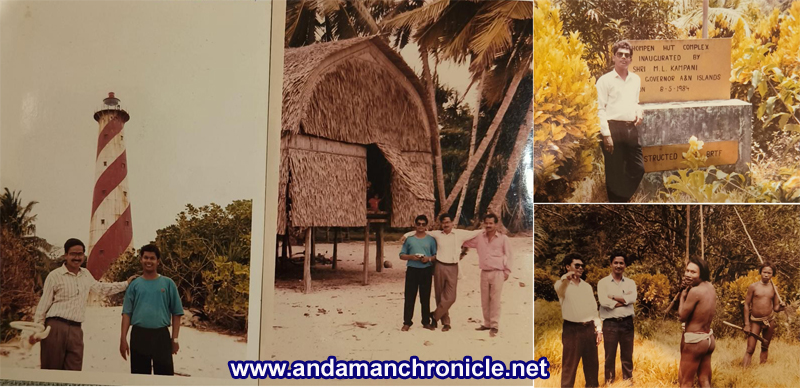
In 1993, during a deputation on official duty from Car Nicobar to Great Nicobar Island, I had the opportunity to serve as a Dental Surgeon in one of the country’s most remote regions. The assignment, though administrative in nature, unfolded as an immersive experience in terrain, ecology and community life at the margins of the Indian Union. I was also, on occasion, deputed on duty-cum-tour to conduct dental camps at Katchal, Nancowry, and Campbell Bay, extending essential oral healthcare services to remote island communities.
A notable part of the visit was to the Shompen hut complex, in Great Nicobar Island where I briefly interacted with the reclusive Shompen tribe, accompanied by Shri. Manoj Parida, IAS, then Deputy Commissioner of Nicobars District. As we approached the huts, members of the tribe were seen holding dahs (traditional machete-like tools) & long sticks. On noticing our presence, they began clearing small plants and creepers in the vicinity, an instinctive response that reflected both alertness and familiarity with their forest surroundings. Officials of the Andaman Adim Janjati Vikas Samiti (AAJVS) were present at the site and facilitated the interaction; during the visit, cooked rice was served at the hut complex around lunchtime. The engagement, conducted with necessary restraint, included a general health assessment with particular attention to oral hygiene. Even within its limited scope, the visit underscored the complexities of extending healthcare to indigenous communities with minimal external contact.
The journey to Indira Point (formerly Pygmalion Point) proved as instructive as the destination itself. Travel conditions were demanding. At one stretch, we crossed the Galathea River over a partially broken wooden bridge, negotiating it cautiously before continuing on motorcycles through difficult patches. Much of the route consisted of narrow tracks, often barely wide enough for a motorcycle tyre, with the sea on one side and steep cliffs on the other, leaving little margin for error. We were advised to halt en route to witness turtle nesting along the coast, an event for which the region is known, but constraints of time required us to forgo the opportunity and proceeded back to Campbell Bay.
Along the way, the island’s biodiversity revealed itself in quiet abundance. Troops of monkeys were a frequent sight on the road. At one point, we halted to observe a large mound-like structure, the nesting site of the Nicobar megapode bird. Such nests, distinctive and not easily spotted without prior knowledge, offered a rare glimpse into the unique ecological adaptations of the island’s fauna. The surrounding landscape near Campbell Bay was equally striking, with dense vegetation and an array of wild orchids, some resembling the delicate dove orchid, adding to the visual richness of the terrain.
The delegation also included Shri Azimul Haque, DANICS, Assistant Commissioner, Car Nicobar, and Shri Sanjay Jha, DANICS, Assistant Commissioner, Campbell Bay. At Chingum village, we interacted with members of the Nicobarese tribe, whose relatively settled lifestyle contrasted with the isolation of the Shompen.
Seen in retrospect, the visit was more than a routine field engagement. It brought into focus the logistical challenges of governance and healthcare delivery in remote island territories, while also offering a rare encounter with landscapes and communities that remain largely beyond the reach of everyday experience. For a young medical officer, it was a formative journey marked equally by professional responsibility and the quiet awe of discovery.
The author is a former Dental Surgeon at G.B. Pant Hospital, Port Blair, and Civil Hospital, Car Nicobar.