
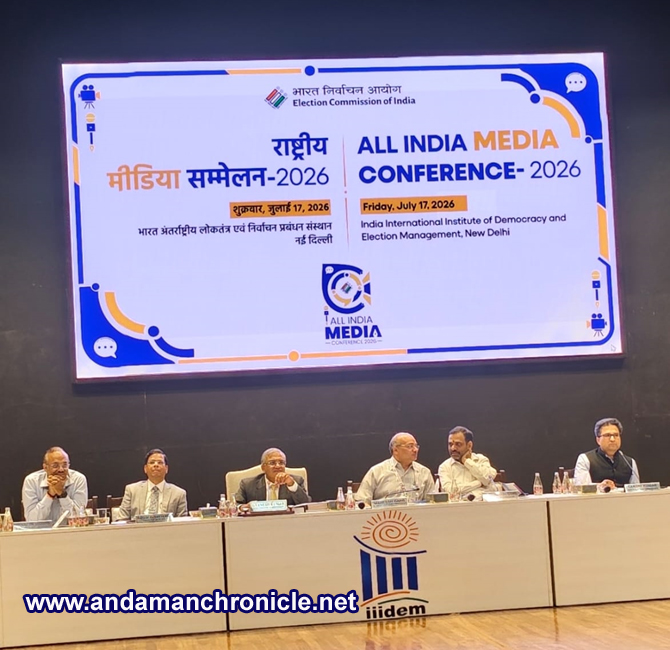
New Delhi, July 17: Asserting that elections in India are conducted strictly in accordance with the Constitution, electoral laws and the instructions of the Election Commission of India (ECI), Chief Election Commissioner (CEC), Shri Gyanesh Kumar today said these principles must be “engrained in the DNA of every member of the Election Commission family, including the media.” Describing the media as the most important stakeholder in democracy, he urged journalists to partner with the Election Commission in ensuring accurate, responsible and fact-based election reporting.
Addressing over 350 media professionals from all 36 States and Union Territories at the All India Media Conference-2026, organised by the Election Commission of India at the India International Institute of Democracy and Election Management (IIIDEM), Dwarka, New Delhi, the CEC said the conference was aimed at building a stronger partnership with the media and equipping journalists with a better understanding of the country’s electoral processes.
The day-long conference was organised to familiarise media professionals with the constitutional, legal, administrative and technological aspects of election management, enabling them to report elections with greater accuracy while effectively countering misinformation and enhancing public awareness.
In his keynote address, Shri Kumar said the media has an indispensable role in communicating authentic information to citizens and strengthening public confidence in democratic institutions. Welcoming the journalists into what he described as the “Election Commission family,” he said their role is crucial in ensuring that factual information reaches every voter.
Highlighting the unprecedented scale of election management in India, the CEC said the Election Commission serves nearly 95 crore electors, making it the world’s largest democratic exercise. During Lok Sabha elections-2024, nearly 1.8 crore personnel were engaged in election management, making it the largest organisational exercise on the planet.
The CEC also highlighted the success of ECINET, the Commission’s integrated digital platform launched in January 2026, which has already recorded over 11.5 crore downloads. The platform, he said, has significantly enhanced transparency by making election-related information and services readily accessible to citizens.
Describing India’s electoral process as one of the most transparent election systems in the world, Shri Kumar said every stage—from preparation of electoral rolls to polling and counting—is carried out through a robust system of concurrent audits and multiple layers of verification involving Booth Level Officers (BLOs), Booth Level Agents (BLAs), polling agents of political parties and election officials. He said this transparent framework has earned global recognition, with nearly 40 democracies visiting IIIDEM to study India’s election management practices.
The CEC elaborated on the Special Intensive Revision (SIR) exercise, clarifying that its objective is only to remove Absent, Shifted, Dead, Duplicate and Foreigner (ASDDF) entries from electoral rolls while ensuring that all eligible citizens aged 18 years and above remain enrolled. He emphasised that the exercise is firmly rooted in Article 326 of the Constitution, the Representation of the People Act and the Election Commission’s statutory powers. He explained that the exercise seeks to maintain the purity and accuracy of electoral rolls through continuous field verification and public participation.
Speaking on voter participation, Shri Kumar pointed out that several Indian States have consistently recorded voter turnouts higher than many countries where voting is compulsory. Citing examples of Bihar, Kerala, Tamil Nadu, Assam, Puducherry and West Bengal, he said the impressive voter turnout reflects the strength, inclusiveness and vibrancy of India’s democratic system.
He further underlined that around 12 lakh Booth Level Officers (BLOs) and 15 lakh Booth Level Agents (BLAs) are engaged in the continuous updation and verification of electoral rolls across the country. Their door-to-door verification and concurrent audit by political parties ensure transparency, inclusiveness and accuracy in voter registration, he added.
Stressing the importance of responsible journalism, the Chief Election Commissioner urged media organisations to verify facts from authentic sources and avoid being influenced by unverified narratives. Reaffirming the Election Commission’s commitment to transparency, he said all instructions, electoral data and procedural details are available in the public domain, enabling journalists to access authentic information with ease.
Welcoming the participants, Director General (Media), Shri Ashish Goyal, said the conference had brought together journalists representing every region and language of the country. He briefed the gathering on the day’s proceedings, which included sessions on the role of media in elections, the ECINET digital platform, constitutional provisions and electoral laws, besides practical demonstrations on electoral roll preparation, polling and counting processes. Participants also witnessed hands-on demonstrations and enthusiastically participated in an interactive quiz on election management.
The conference concluded with an interactive question-and-answer session during which the Chief Election Commissioner responded to a wide range of queries from journalists on election management, electoral reforms, voter services, technology adoption and the Commission’s ongoing efforts to strengthen democratic institutions.
The All India Media Conference-2026 marks a significant initiative by the Election Commission of India to strengthen its partnership with the media by enhancing journalists’ understanding of electoral processes. By promoting informed, factual and responsible election reporting, the conference seeks to combat misinformation, deepen democratic participation and reinforce public trust in India’s free, fair and transparent electoral system.