
By Asheesh Poddar
There are some people who never physically enter our lives, yet somehow become members of our family. Rabindranath Tagore was exactly that to me—not related by blood, yet one of my dearest companions of the heart.
From my earliest childhood, I never thought of him as merely India’s Nobel Laureate or one of the world’s greatest poets. He was simply a part of our home. He lived in the atmosphere around us—in the books that lined our shelves, in framed portraits, in sketches and works of art, in the songs that filled our rooms, in my father’s conversations, and in the cultural life that surrounded my childhood. His presence felt so natural that I never consciously ‘discovered’ Rabindranath; I simply grew up with him.
His novels, short stories, poems, essays, paintings and songs were woven into our everyday life. Knowing him was never part of a formal education. It was simply part of growing up.
My father was an exceptional teacher and a remarkably learned man. His understanding of Rabindranath’s literature, music, philosophy, educational ideas and paintings was profound. Our home frequently became a gathering place for his friends and colleagues, many of whom shared his love for literature. Their conversations almost invariably found their way to Rabindranath. They spoke about his poetry, songs, plays, novels, philosophy, social ideas and even his paintings.
As a little boy, I would quietly sit nearby and listen. I understood very little of those discussions then, yet instinctively I sensed that this extraordinary man possessed something timeless that continued to inspire generation after generation.
Many of my father’s friends were devoted admirers of Rabindranath’s songs, known as Rabindra Sangeet. Their wives, too, sang beautifully. Among them, I especially remember Smt. Tripti Sanyal, whom I affectionately regarded as an elderly aunt. Her voice remains unforgettable in my memory. Listening to her sing Rabindranath’s songs, I slowly began to realise—even as a child—that Rabindra Sangeet was not merely music. It was emotion, philosophy and devotion expressed through melody.
Our next-door neighbour, whom we all lovingly called Chakraborty Kakima, was another wonderful singer. Quite often, Rabindranath’s songs would drift into our home from hers through the open windows, gently floating across the quiet neighbourhood. At the time I simply enjoyed those melodies. Looking back today, I realise how naturally and effortlessly Rabindranath became a part of my childhood through people like her.
My father was primarily a singer of Bhatiali, the traditional river songs of Bengal sung by boatmen. Yet every now and then he would sing Rabindranath’s songs as well. I loved listening to Rabindra Sangeet in my father’s voice. Today I realise that those songs touched me so deeply because they carried not only the beauty of Rabindranath’s compositions but also the warmth, affection and love of my father.
Then one day a gramophone arrived in our home, and with it came Rabindranath in yet another unforgettable way. The immortal voices of Pankaj Mullick, Debabrata (George) Biswas, Hemanta Mukhopadhyay and Suchitra Mitra filled every corner of our house. Those songs entered not only my ears but slowly settled deep within my heart.
Many years later, I experienced another unforgettable joy. I heard Rabindra Sangeet rendered by Kishore Kumar—the singer who had been my greatest musical hero throughout my childhood and adolescence. It was an indescribable feeling. It seemed as though my two greatest loves—Rabindranath and Kishore Kumar—had suddenly met each other. Out of affection, I lovingly call Kishore Kumar my other ‘Thakur’—my ‘Guru Thakur.’ The meeting of my two ‘Thakurs’ remains one of the most treasured memories of my life. Even today, words fail to describe the happiness I felt.
The cultural programmes organised by Atul Smriti Samity, our Bengali cultural club, were another important part of my growing-up years. Every year, the celebrations of Rabindranath’s birth anniversary in May and the observance of the anniversary of his passing in August were occasions I eagerly awaited. I would sit spellbound, listening to his songs, poems and recitations. Those programmes were far more than cultural events; they quietly carried Rabindranath’s spirit from one generation to the next.
Life later offered me an unexpected blessing. The very stage from which I had once watched those programmes in admiration eventually became the stage on which I myself performed during the annual Rabindranath celebrations. To stand there as an artist, where I had once sat as an awestruck child, remains one of the most meaningful experiences of my life. Even today, memories of that stage, that atmosphere and those evenings fill my heart with gratitude.
As I grew older, I realised that Rabindranath was far more than a poet. He was an entire universe. Literature, music, education, painting, philosophy, social thought and humanism—whatever he touched acquired extraordinary depth and beauty. The more I read, listened and understood, the greater my wonder became. I often found myself asking how one human being could leave behind such an astonishing legacy in a single lifetime.
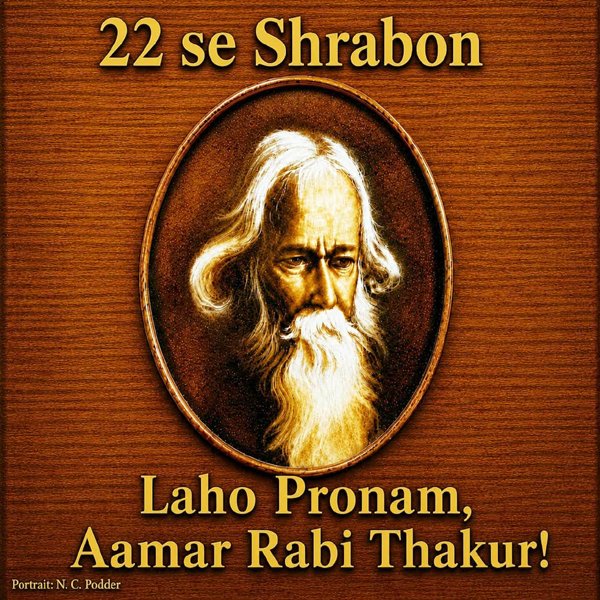
Every year, when 22 Shraban arrives—the day on which Rabindranath passed away—my mind travels back to those cherished days: the fragrance of old books; my father’s discussions; the literary gatherings at home; the voices of Mrs. Tripti Sanyal and our beloved Chakraborty Kakima singing Rabindra Sangeet; my father’s effortless transition from Bhatiali to Rabindranath’s songs; the gramophone playing Pankaj Mullick, Debabrata (George) Biswas, Hemanta Mukhopadhyay and Suchitra Mitra; later, Rabindra Sangeet in Kishore Kumar’s incomparable voice; and the unforgettable programmes dedicated to Rabindranath on the stage of Atul Smriti Samity.
At such moments, Rabindranath never feels like someone who belonged to another century. Instead, he feels inseparably woven into my childhood, my adolescence, my journey through life, and the person I have become.
Looking back today, I realise that I did not merely read Rabindranath. I did not merely listen to him. Nor did I simply learn about him. I experienced him—little by little, at every stage of my life. My childhood home, my family’s cultural environment, my father’s scholarship, the voices of people I loved singing his songs, the gramophone that endlessly played his music, and finally my own journey as a performer on the very stage where I had once admired others—all of these gradually made him an inseparable part of my life.
Today I know that the foundations of my values, my aesthetic sensibilities, and my love for literature and music were laid in that childhood environment. At the heart of that foundation stood Rabindranath—a quiet yet constant source of inspiration. To me, he is far more than a Nobel Laureate or a world poet. He is the foundation of my cultural identity, the language of my emotions, the light that guides my thoughts, and an inseparable companion throughout my life.
That is why 22 Shraban is much more than the anniversary of the passing of a great man. It is also a day of personal reflection—a day when I pause to realise how deeply my thoughts, emotions, love of beauty, literature and music continue to bear his silent imprint. Times have changed. Generations have changed. Life has taken me through countless experiences. Yet Rabindranath remains as natural, as intimate and as deeply present in my life today as he was in my childhood.
On this sacred day of remembrance, my heart overflows with reverence, gratitude and boundless love with deepest reverence to my beloved Rabi Thakur!