
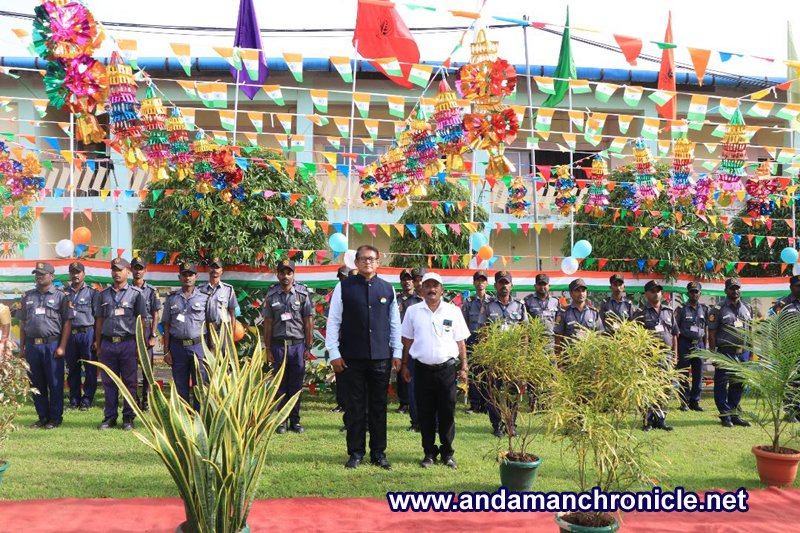
Sri Vijaya Puram, Aug 16: The ICAR-Central Island Agricultural Research Institute (ICAR-CIARI) commemorated the 80th Independence Day with great patriotic enthusiasm at its headquarters at Garacharma, Sri Vijaya Puram, as well as at the Regional Centre, Minicoy, Lakshadweep, and KVKs in South Andaman, North & Middle Andaman and Nicobar. The celebrations witnessed enthusiastic participation of staff, students and their families, creating a vibrant atmosphere of national pride and unity.
The celebrations commenced with the hoisting of the National Flag by Dr. Jai Sunder, Director, ICAR-CIARI, followed by the National Anthem. Addressing the gathering, Dr. Jai Sunder paid tribute to the freedom fighters and national leaders whose sacrifices and contributions paved the way for India’s independence. He highlighted the remarkable journey of the nation over the last eight decades and recalled the significant contribution of the Indian Council of Agricultural Research (ICAR) towards India’s agricultural transformation, food security and self-reliance.
Dr. Jai Sunder stated that as India moves towards celebrating 100 years of independence, ICAR is also progressing towards its centenary, while ICAR-CIARI is approaching its 50th year of dedicated service to island agriculture. He emphasized that over the past 80 years, ICAR has played a pivotal role in enhancing agricultural production, strengthening food and nutritional security, promoting crop diversification and developing technologies suited to diverse agro-ecological conditions.
Highlighting the recent achievements of ICAR-CIARI, he informed that 18 crop and spice varieties were recommended for release through the State Seed Sub-Committee, including rice, mung bean, urd bean, brinjal, Malabar tamarind and tejpat. These varieties are expected to contribute to nutritional security, crop diversification and agricultural self-reliance in the island ecosystem. On climate-resilient agriculture, Dr. Jai Sunder highlighted the identification of the rice line Dweep Dhan-11, which possesses superior tolerance to flood and salinity and holds considerable promise for climate-resilient rice production in island conditions.
He further informed that during the year, the Institute strengthened its intellectual property portfolio by filing three patents, ten design registrations, three trademarks and two copyrights. Two technologies were also successfully commercialized/transferred for wider adoption and upscaling, reflecting the Institute’s commitment to translating research into technologies for the benefit of farming and allied communities.
Speaking on fisheries and aquaculture, he highlighted the Institute’s efforts in standardizing biofloc technologies, seaweed cultivation and aquaculture practices for island farmers. Under coastal and marine resource management, 32 years of shoreline data were mapped for the Car Nicobar Management Plan, and high-suitability zones for aquaculture were identified. In Minicoy, a second Fish Aggregating Device (FAD) was deployed to enhance tuna catches while reducing fuel consumption, thereby supporting the livelihoods of fishing communities.
Dr. Jai Sunder also highlighted the strengthening of agrometeorological services at the Institute. The Agro-meteorological Observatory was upgraded under the IMD-sponsored Gramin Krishi Mausam Seva (GKMS) project. Location-specific agrometeorological advisories were disseminated through multiple platforms, enabling farmers to make timely and informed decisions relating to crop and farm management.
He appreciated the efforts of the Institute in implementing the Government of India initiative Khet Bachao Abhiyan, with emphasis on balanced fertilizer use, vermicompost, green leaf manure and biological control agents such as Trichoderma. The Institute also renovated its vermicompost unit to promote recycling of farm waste, resource conservation, diversification and efficient utilization of farm resources. Quality planting materials and seeds were produced and supplied to island farmers during the year.
Dr. Jai Sunder emphasized the importance of sustainable and green energy, highlighting the installation of a solar energy system at the Institute to reduce dependence on conventional power sources, with plans to extend similar green-energy initiatives to other locations, including KVKs. He also congratulated the Institute’s scientists for preparing a contingency plan to address the potential impacts of El Niño in the islands and appreciated the efforts towards implementing institutional frameworks for data sharing, communication, gender mainstreaming, and MELIA (Monitoring, Evaluation, Learning and Impact Assessment), thereby strengthening transparent, inclusive and evidence-based agricultural research and development.
Dr. Jai Sunder congratulated the scientists and staff members who received awards, recognitions and other distinctions for their contributions. He called upon all scientists and staff to continue pursuing excellence in research, technology development and extension activities and to work with greater dedication towards improving the livelihoods and welfare of the farming and fishing communities of the islands.
The celebrations concluded with a colourful cultural programme, featuring various performances and fun activities by staff, students and their families. Prizes were distributed to the winners and participants in recognition of their enthusiastic participation.
The 80th Independence Day celebration at ICAR-CIARI thus reflected the Institute’s commitment to the nation’s agricultural progress, sustainable island development and the vision of a self-reliant and resilient India.