
Know your Shore – By Nature Conservation Foundation
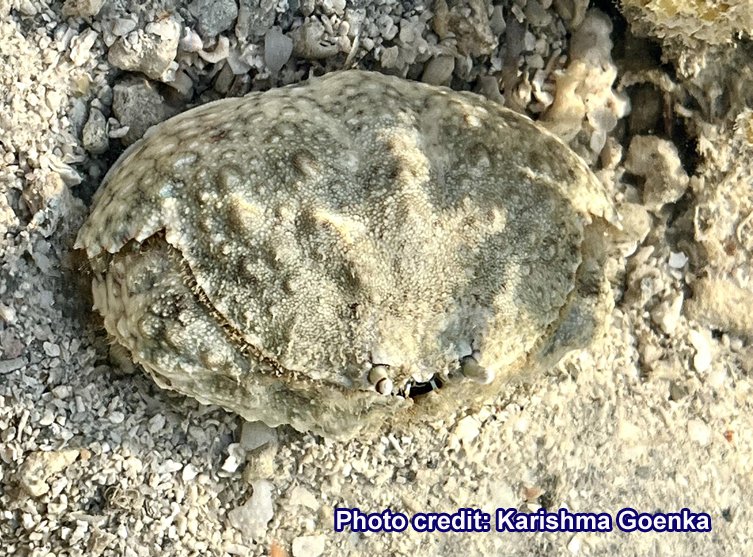
If you find yourself walking through the waters of a shallow sandy beach, and suddenly notice a random pebble moving, you have probably seen a common box crab, also known as a shame-faced crab.
Unlike most crabs that scramble away when danger appears, the box crab has a totally different trick. It folds itself up like a smooth, hard pebble. By tucking its legs underneath its shell and folding its wide, flat claws perfectly against its face, it hides every soft part of its body. To a hungry predator, it would look like an ordinary rock rather than a delicious meal.
This clever defense is also how the crab earned its quirky nickname. Both of its flattened claws fold so neatly across its front that it comically resembles someone covering their mouth in shame.
These crabs are also great at partially burying themselves under soft sand leaving only their stalked eyes exposed, often ambushing their prey. Like many other crabs, their claws are used to crack open shells of snails, clams and hermit crabs, among other shellfish.