
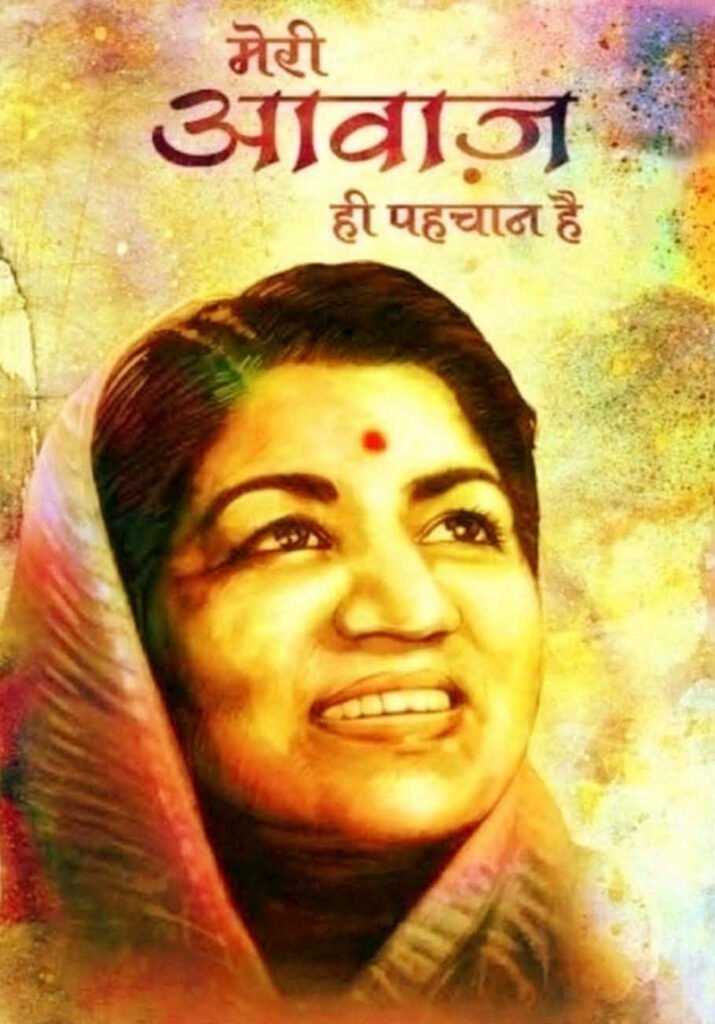
By Ashees Poddar
On her 97th birth anniversary, Lata Mangeshkar is remembered not only for the voice that became a nation’s memory, but also for the voice she raised to secure recognition and rights for playback singers.
There was a time when a singer’s voice could fill cinema halls, captivate millions and become inseparable from a film’s identity, yet the person behind that voice could remain unacknowledged. In the Hindi film industry of the 1940s, playback singers were often absent from record labels and film credits. Lata Mangeshkar challenged that convention, insisting that the singer deserved to be identified by name.
The story of Aayega Aanewala from Mahal (1949) brought this issue into sharp focus. The record initially carried the name of the character, Kamini, rather than that of the singer. As listeners sought to know who had sung the song, Mangeshkar pressed for playback singers to receive proper credit. The appearance of singers’ names on records and film screens marked a significant change in the industry’s recognition of the artists behind the voices.
But recognition, for her, could not end with a name printed on a record or displayed on a screen. It had to extend to the financial value of a singer’s contribution. In the early 1960s, she began advocating for royalty payments, challenging the practice of treating a song as a one-time engagement even when it continued to generate revenue through recordings and broadcasts. Her demand brought the question of a singer’s continuing stake in a musical work into the industry’s wider conversation.
The issue was not merely personal remuneration. It concerned the status of playback singers in an industry where composers, lyricists and producers had established claims, while singers’ rights remained limited. The campaign for royalties and performers’ rights continued over the decades, eventually becoming part of the broader movement that led to changes in India’s copyright law in 2012. Those legal developments were the outcome of wider advocacy and collective efforts, but Mangeshkar’s early and sustained interventions formed an important part of the debate.
Her professional life also reflected a determination to be taken seriously beyond the recording studio. She was known for her insistence on discipline, preparation and professional standards, and she used her standing to raise questions that affected fellow singers. Her public stature gave weight to issues that might otherwise have remained confined to private negotiations between performers and producers.
The artistic legacy, of course, needs little introduction. From Mahal to Mughal-e-Azam, from devotional compositions to film songs that became part of everyday life, her voice established a place in India’s cultural memory. The Bharat Ratna, conferred on her in 2001, recognised a career whose influence extended far beyond the boundaries of cinema.
Yet the story of Lata Mangeshkar cannot be told only through melodies, awards and records. It also belongs to the history of a profession learning to claim its identity. She helped bring the playback singer out of anonymity, insisted that the voice behind the song deserved acknowledgment, and raised the question of whether that voice should share in the value it created.
On her 97th birth anniversary, the significance of “Meri Awaaz Hi Pehchaan Hai” reaches beyond the familiar meaning of a voice recognised by millions. It also evokes a singer who raised that very voice for recognition, dignity and rights—not only for herself, but for the profession she helped redefine.