
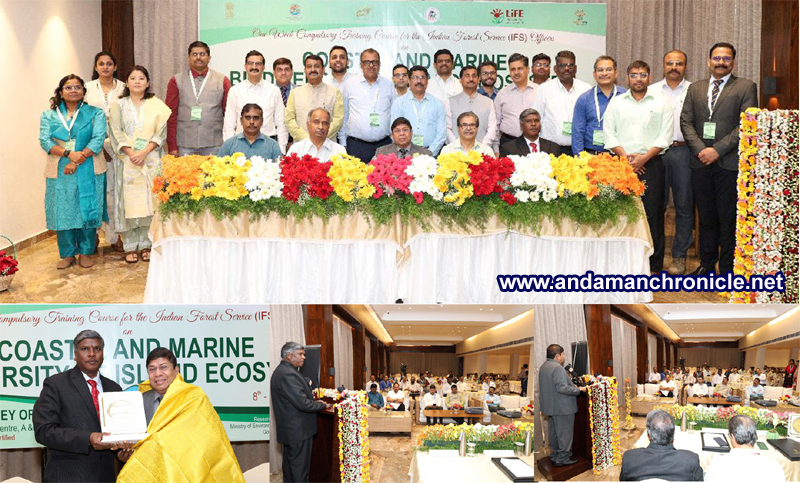
Sri Vijaya Puram, Dec. 8: The Inaugural Function of the one-week compulsory training course for the Indian Forest Service (IFS) officers on “Coastal and Marine Biodiversity of Island Ecosystem” was held today at Sea Shell Coral Cove, Minnie Bay. The training programme is sponsored by the Ministry of Environment, Forest and Climate Change (MoEFCC), Government of India. A total of 21 IFS officers from various states and union territories including Andhra Pradesh, Bihar, Chhattisgarh, Gujarat, Haryana, Himachal Pradesh, Jharkhand, Karnataka, Manipur, Orissa, Telangana and Uttar Pradesh are attending the training. The course has been designed to include both classroom sessions and practical field exercises, aimed at equipping officers with in-depth knowledge of resource management and conflict resolution approaches, particularly in sensitive and ecologically fragile landscapes.
Shri. G. Balachandran, IAS, Former Secretary, Government of India was the Chief Guest; Dr. R.S.C. Jayaraj, IFS, Former Principal Chief Conservator of Forests (PCCF), A&N Islands, Dr. Deepak Apte, Director – Advanced Research Centre (Ecology & Conservation), DES Pune University, Pune & Former Director, Bombay Natural History Society, Dr. S. Dinesh Kannan, IFS, Chief Conservator of Forests (Wildlife) (CCF), Department of Environment and Forests, A & N Islands was the special guests.
Shri G. Balachandran, in his inaugural speech emphasised that conservation is closely intertwined with social and economic realities, pointing out that decisions made in one area, whether on the mainland or the islands, directly affect other areas. He reminded them that we are stewards of these ecosystems, not just users, and cited a landmark plea by the Indian president to safeguard the Andaman and Nicobar Islands.
Dr. R.S.C. Jayaraj in his address highlighted that over the past three years, the training program has been efficiently planned and executed. He explained that although the training was first created only for Forest Department officers, sponsorship was later extended to officers from other services in recognition of their equally significant roles in resource management. He underlined how forest management has an impact that goes much beyond the boundary of forests, influencing coastal zones, sculpting landscapes, and eventually affecting marine ecosystems.
Dr. Deepak Apte in his speech emphasised how conservation is becoming a more complex issue and that it is now intricately linked to social, economic, and developmental aspects. He emphasised how crucial the Zoological Survey of India is in creating methodical, scientifically grounded monitoring frameworks to close these gaps. He emphasised that biological, economic, and governance limitations make it challenging to meet India’s pledge to safeguard 10% of its maritime areas, which is a global concern. He suggested adaptive spatial planning strategies as a means of moving forward, including temporary exclusion zones, seasonal protections, and rotational closures.
Dr. S. Dinesh Kannan in his address highlighted the vital role that marine and coastal biodiversity play in maintaining human communities and ecosystems. He emphasised that because of their geographic isolation, unique evolutionary patterns, and high biodiversity, island ecosystems need management strategies different from those employed in mainland areas. He appreciated the comprehensive structure of the training, which integrates classroom sessions with practical experience and fieldwork to help trainees comprehend the difficulties of managing delicate island ecosystems in the real world.
Earlier, Dr. C. Sivaperuman, Scientist-F & Course Director, in his address outlined the objectives of the training programme. Highlighting that this is the sixth training course in the last three years and the second under the current year. A total of 21 officers from various organisations are attending the programme. He informed that the course brings together eminent specialists, senior scientists and experienced resource persons who will deliver technical lectures, demonstrations and hands-on sessions. He also highlighted the centre’s ongoing outreach and capacity-building initiatives for teachers and students across the islands. He encouraged participants to engage actively in discussions and knowledge-sharing, underscoring the value of meaningful interactions and collaborative learning.
The technical session starts with insightful lectures; Dr. C. Sivaperuman, Scientist-F & Officer-in-Charge, ZSI, delivered a lecture on “An overview of Biodiversity of A & N islands with special reference to the Marine Ecosystem”, followed by Dr. K. Sivakumar, Professor, Pondicherry University on “Introduction to the Management of Coastal and Marine Biodiversity in India: Challenges and Prospects”. Dr. Deepak Apte presented an enriching talk on “Intertidal Marine Biodiversity, Conservation and Challenges”. Dr. S. Dinesh Kannan, delivered a talk on “Sustainable Management of Biodiversity of Island Ecosystems”.