
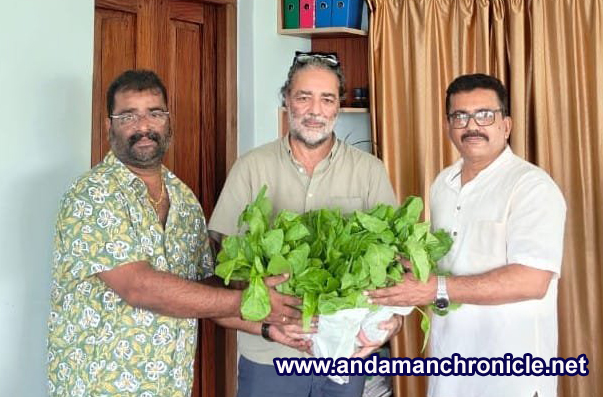
Sri Vijaya Puram, Dec. 15: The Andaman and Nicobar Islands quietly crossed an important agricultural milestone this week with the successful harvest from the first high-tech hydroponic farming unit ever established in the archipelago. Located at Kalapathar in Swaraj Dweep (Havelock Island), the unit marks the introduction of a modern, soil-free cultivation system uniquely suited to the ecological and logistical realities of island territories.
The pioneering initiative has been set up by Shri. Himmat Singh, a retired civil servant with long experience and domain knowledge in agriculture-led rural development and income generation. Conceived as a proof-of-concept, the project seeks to demonstrate how advanced farming technologies can be localised and adapted for island conditions, rather than remaining confined to mainland or metropolitan contexts.
From Concept to Cultivation
The hydroponic unit was developed after careful site selection and land preparation, with Shri Sanjay Balan and Shri Johnny closely associated with the project from its formative stages. The emphasis throughout was on practicality—understanding island constraints, climate behaviour, logistics, and scalability—rather than merely showcasing technology.
The first successful trial crop, exotic spinach, has now been harvested, marking the operational validation of the system. Further trials are already underway for zucchini, lettuce, and bell peppers, crops that are in high demand locally but are currently dependent on mainland supply chains.
Why Hydroponics Matters for the Andaman & Nicobar Islands
The significance of this development lies not merely in novelty, but in context.
Despite abundant rainfall, much of the Islands’ soil presents limitations for intensive, high-value vegetable cultivation. At the same time, the rapidly growing needs of local residents, tourists, and the hospitality sector are met largely through air-lifted fruits and vegetables from the mainland. This dependence carries multiple penalties: reduced freshness and nutrition, high costs, post-harvest losses, and a significantly increased carbon footprint.
Hydroponics directly addresses these challenges. By growing plants in a controlled, soil-free environment and supplying precisely calibrated nutrients, the system optimises water use, avoids indiscriminate application of pesticides and fungicides, and ensures uniform crop health. The technology is inherently resource-efficient—an important consideration in fragile island ecosystems.
The First Harvest: A Quiet but Powerful Moment
The first hydroponic spinach crop was harvested at 6:30 a.m. and reached its recipients in Port Blair by midday—without any cold-chain support. The produce retained its pristine freshness, underscoring one of hydroponics’ most compelling advantages: near-zero time between harvest and consumption.
This inaugural harvest is more than symbolic. It demonstrates that fresh, high-quality greens can be grown within the Islands themselves and supplied rapidly, reducing dependence on long, carbon-intensive supply routes.
In a small but meaningful gesture reflecting community engagement, the first batch of hydroponic greens is being cooked and evaluated to provide feedback on taste, texture, and culinary adaptability—an important step in aligning production with consumer acceptance.
Nutrition, Environment, and Livelihoods
Hydroponically grown produce is, by the very nature of the technology, nutritionally superior in many respects. Each plant receives exactly the nutrients it requires, resulting in consistent quality and higher nutrient uptake. Equally important is what the process avoids: excessive chemical inputs that degrade soil, water, and long-term ecological health.
Beyond nutrition and sustainability, hydroponics also holds significant livelihood potential. The technology is scalable and can generate employment while offering small and marginal farmers an opportunity to move towards higher incomes through controlled, high-value cultivation. For island economies—where land availability, soil variability, and logistics impose structural constraints—this represents a promising pathway.
Consumers, too, stand to gain: fresher produce, better nutrition, and reduced exposure to chemical residues.
A Proof-of-Concept, Not a One-Off
It is important to note that this is a private initiative, consciously designed as a demonstration rather than a commercial rollout. The intent is to localise the technology, understand operational challenges, and evolve island-specific solutions before wider replication.
As Shri Himmat Singh has candidly observed, this trial was possible because of prior domain knowledge and close, hands-on involvement by a small team. For hydroponics to move from a pioneering experiment to a mainstream agricultural option, sustained hand-holding, training, and institutional support will be essential.
This is where the role of the Administration becomes crucial—not necessarily through subsidies alone, but through facilitation: technical guidance, pilot programmes, skill development, and integration with existing agricultural and livelihood schemes.
Looking Ahead
The successful commissioning and first harvest of the Swaraj Dweep hydroponic unit should be seen as a signal moment. It challenges long-held assumptions about what can and cannot be grown in the Islands and opens a conversation about how technology, when thoughtfully adapted, can strengthen food security while respecting ecological limits.
In an era where sustainability is no longer optional, the Andaman and Nicobar Islands may well find in hydroponics a tool that aligns economic resilience with environmental responsibility. The quiet success at Kalapathar suggests that the future of island agriculture need not always arrive by air—it can grow, quite literally, at home.