
By Dr.Dinesh
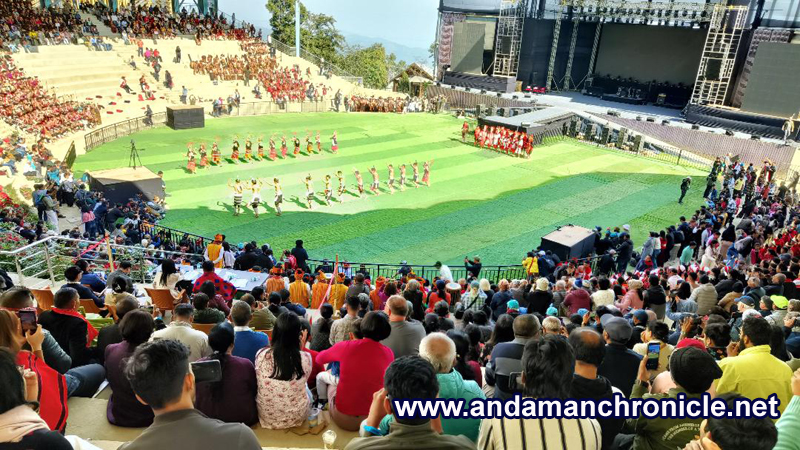
Every winter, the Naga Heritage Village at Kisama transforms into a living museum of culture, colour and continuity. The Hornbill Festival, now one of India’s most recognised cultural showcases, draws thousands of visitors who arrive not merely to witness performances, but to understand the lived traditions of Nagaland’s many tribes. “What emerges on the ground is a portrait of a society negotiating heritage, modernity, pride and change, said Dr. Moa Jamir a native of Dimapur.
The amphitheatre at Kisama begins stirring early. Smoke from bamboo kitchens curls into the cold morning air, carrying the scent of sticky rice, smoked pork and axone. Performers from the Ao, Angami, Chang, Konyak, Sumi and other tribes gather in clusters, adjusting headgear, checking spears, tying shawls whose patterns tell stories older than the state itself. For most participants, the festival is not a show staged for tourists, but a moment to affirm identity before their own people.
Across the sprawling grounds, each morung, the traditional youth dormitory, functions as a cultural embassy. Visitors walk through them not as spectators but as learners, pausing to watch basket-making, wood-carving, millet pounding or bead-stringing, crafts that have survived generations of upheaval. Elders narrate myths and migration stories, while younger volunteers translate them into English or Hindi, bridging a gap between oral tradition and contemporary curiosity.
Yet the festival is not without its tensions. Alongside the rhythmic log-drum beats and warrior dances, the commercial zone hums with souvenir stalls, food courts, and government pavilions promoting tourism, entrepreneurship and rural livelihood schemes. For some locals, the rapid scale-up over the past decade raises questions, how much commodification is too much? Can the authenticity of lived culture endure the pressures of performance?
Still, many tribes have embraced the platform as a space to showcase what might otherwise fade. Several youths told me that participation reinforces skills that have waned in the era of smartphones and migration. “We learn our dance steps from our grandmothers,” a young Chakhesang performer said. “If we don’t present them here, where will the next generation learn?”
The evenings at Kisama belong to music, contemporary, folk and fusion. Younger artists blend Naga harmonies with rock, gospel and indie influences, drawing crowds from across the country. For them, the Hornbill stage is both validation and visibility.
Beyond entertainment, the festival has economic significance. Hotels in Kohima operate at full capacity, homestays in nearby villages thrive, and local artisans often earn their highest annual income during these ten days. The government emphasises that Hornbill is not merely an event but an ecosystem that generates livelihood and international goodwill.
Yet a ground view also reveals the challenges, traffic bottlenecks, waste management concerns, and the need for better infrastructure connecting remote villages to the festival circuit. Dr. Biswajit Mondal & family from Kolkata had a difficult time to book taxi that too few months in advance. Local groups argue that benefits must reach the deeper rural pockets that preserve the very traditions being celebrated.
As the sun sets behind the Japfu range and the final drumbeats echo through the hills, one realises that the Hornbill Festival is more than spectacle, “It is a negotiation, between memory, aspiration, between rootedness and reinvention”, said Dr. Arenla Walling Thong, Director of Health Services (Dental) Nagaland. In a state where oral history is the backbone of identity, the festival keeps those stories alive, not on museum shelves but in the voices, rhythms and rituals of the people themselves.
Andaman and Nicobar Islands are often called Mini India because people from almost every state have made these Islands their home. This diversity itself is a cultural asset. Just as the Hornbill Festival brings together the many tribes of Nagaland, the Island Tourism Festival (ITF) from next year onwards can dedicate one day to each Indian state, allowing communities to present their food, dance, music, crafts, and attire.
Such state-themed days would celebrate the Islands’ social harmony, deepen community participation, and give visitors a vivid glimpse of India’s cultural mosaic, right here in the Andamans.
*The author is a Dental Surgeon & Freelance Journalist. E-mail:-dineshdentalclinic@gmail.com