
Through the International Visitor Leadership Program, Indian professionals explore how the United States combines innovation, education, and security to strengthen cybersecurity and guide AI development.
By Krittika Sharma, SPAN Magazine
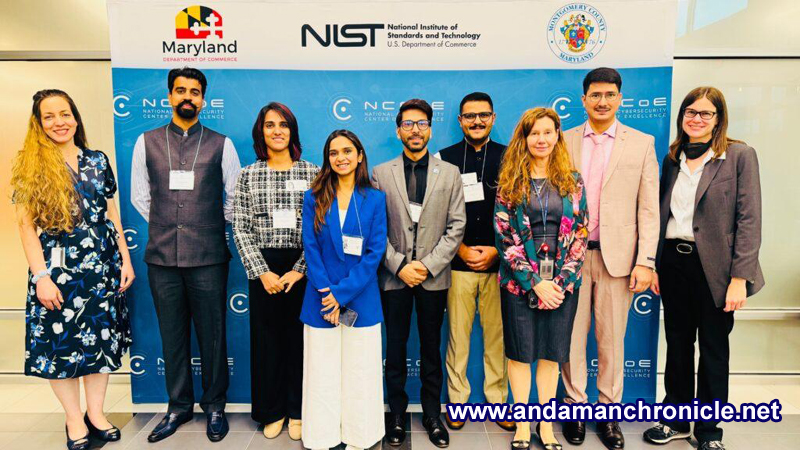
How do countries protect digital infrastructure and citizens when artificial intelligence (AI) and cyber threats evolve faster than regulation? Securing cyberspace is complex because malicious actors operate across borders and vulnerabilities in vast networks keep emerging. Beyond individual precautions, governments and industry depend on multi-layered strategies to protect critical infrastructure. A key part of the answer is international cooperation that leverages U.S. technological leadership and practical security models.
In May 2025, a group of Indian professionals visited the United States through the State Department’s International Visitor Leadership Program (IVLP) to study U.S. approaches to cyber defense and incident response and explore potential collaborations to strengthen India’s cybersecurity capacity. They engaged with officials from the Departments of State , Commerce , War , and Homeland Security , as well as experts from think tanks, educational institutions, and local governments.
Exploring the U.S. model
Kazim Rizvi, founder of The Dialogue, a tech policy think tank; Pragya Singh, who leads strategic alliances and wellness operations at her start-up Raha Fintech; and Swati Kumari, vice president for operations at QpiAI in Chennai, describe the program as a practical study of U.S. approaches to AI and cybersecurity and their applicability in India.
Their trip to Washington, Seattle, San Antonio, and Orlando offered insight into how innovation thrives through a combination of culture and structure. “They can fund a research project and not worry if it fails,” says Rizvi. “Even failure is a success because it shows what doesn’t work.” He was particularly impressed by the openness to test ideas and co-create policy across sectors.
Kumari was struck by the strong collaboration between industry and academia. “What makes the U.S. stand out is its deep research base anchored in academic institutions,” she says. “Research follows industry needs, and education evolves to build skills that will be needed five to ten years down the line.”
During the IVLP, Singh observed how U.S. policies integrate citizen rights into the design of technological systems. “The important point that stood out was the intent—the data belongs to the citizen, and not the government,” she says.
Her key takeaway was how the United States builds an integrated model connecting innovation, governance, and security. “U.S. agencies actively engage with the private sector and academia in real time, whether it’s developing cybersecurity frameworks or shaping guidelines on responsible AI,” she explains.
Complementary strengths and shared goals
Rizvi highlights the synergy of U.S. capital and technology with India’s market and talent. “The United States is the world’s largest economy, and India is the fastest-growing major economy,” he says. “They complement each other in many ways.” He believes collaboration should focus on practical goals like preventing AI misuse, embedding safety into systems, ensuring interoperability, and opening markets for developers.
Kumari adds a practical point, highlighting structural safeguards like zero-trust architecture, a system built on the principle of “never trust, always verify.”
“The U.S. has invested heavily in zero-trust architectures and continuous verification models, which reduce risks from insider threats and compromised credentials. Adopting such models in India, especially in critical sectors like banking and health care, could make a significant difference,” she notes.
Another U.S. practice that serves as a strong model for emulation is public-private threat intelligence sharing. For example, the U.S. Cybersecurity and Infrastructure Security Agency enables real-time sharing of vulnerabilities and threat signatures. “I visited a county with a ‘war room’ setup,” Kumari says. “If there was an alert, teams would immediately activate and respond in shifts. In India, we need a similar model, potentially in partnership with U.S. agencies.” Her key takeaway is that cybersecurity is strongest when treated as a collective defense effort.
Translating innovation into action
Rizvi notes that such practical models depend on stable policy environments. “You need a predictable environment to innovate,” he says, adding that agreed-upon technical standards can create that stability. He also links U.S.-India collaboration to interoperable frameworks that support economic growth. “India and the United States should champion AI in ways that advance both economic and social development,” he says.
Singh highlights how local policy pilots can inspire broader change, citing Seattle’s data-rights policy as an example of city-level innovation shaping information use and rights. These initiatives show how small-scale experimentation can inform larger-scale policy adoption.
Kumari underscores the international dimension, noting that U.S.-India collaboration should translate into tangible initiatives like talent exchanges and joint research hubs. These efforts could accelerate secure scaling of technology and knowledge sharing.