
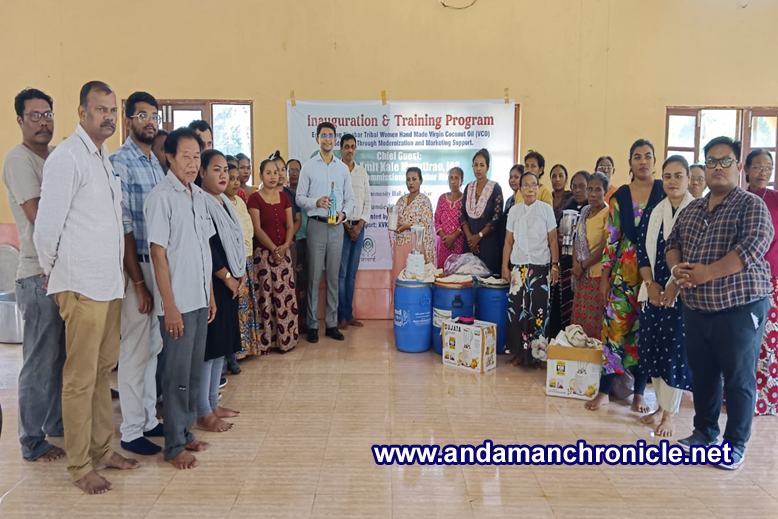
Car Nicobar, Feb. 20: In a landmark initiative to empower tribal women and revolutionize the local coconut economy, a comprehensive training program and workshop was held at the Small Lapathy Community Hall. Kick started by the Deputy Commissioner of Nicobar District, Shri. Amit Kale, IAS, the three-month training and mentoring program aims to equip tribal women producers with modern tools to improve the production and quality of traditional Virgin Coconut Oil (VCO) at home, while strictly maintaining its Geographical Indication (GI) parameters.
Spearheaded by the robust vision and proactive support of the District Administration, this transformative project is made possible through vital funding and institutional backing from NABARD and ITDP Nicobar District. Driven by this strong administrative leadership, the initiative formally inducted its first batch of 30 Self-Help Group (SHG) women from Small Lapathy and Sawai villages. The on-ground, dedicated grassroots facilitation required to execute the Administration’s vision is being expertly managed by partner organization CFBT Education Services.
The Deputy Commissioner officially launched the first bottle of this premium oil. Introducing a name that reflects its true origins a Nicobari homemade product crafted right in the heart of the community the new brand of Tribal Handmade Virgin Coconut Oil was lovingly named “Nico Hut”.
During the launch, Shri. Amit Kale, IAS, engaged in a highly interactive session with the SHG women. Taking a keen interest in the modernization of tribal methods, he personally gathered feedback regarding the constraints and challenges faced by the women producers. Demonstrating unwavering administrative backing, the DC promised to sanction the necessary “gap tools” and additional instruments through ITDP, Nicobar to ease the production process and ensure its sustainability. Stating that this Extra Virgin Coconut Oil will be a “game-changer” for the Nicobarese people, he assured the producers that the District Administration would actively facilitate market linkages spanning local tourist hubs to international markets provided there is consistent, high-quality production.
This intervention goes far beyond a single day of training. As part of a comprehensive 15- month project cycle, each batch of women will receive continuous, hands-on mentoring.