
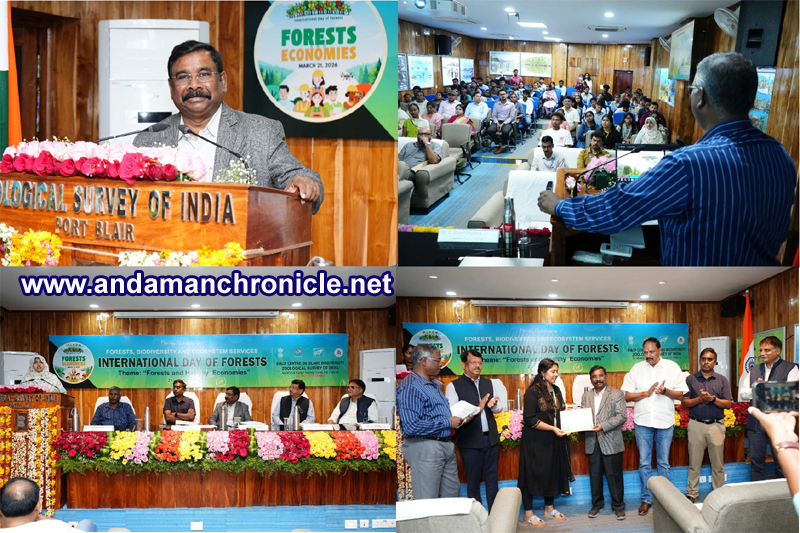
Sri Vijaya Puram, March 22: The EIACP Centre on Island Biodiversity, Zoological Survey of India, Andaman & Nicobar Regional Centre organised a one-day workshop on “Forests, Biodiversity and Ecosystem Services” on 21st March, 2026 as a part of celebration of International Day of Forests. A total of 77 participants, including students and faculty members participated in the workshop from Andaman Law College, ANIIMS, JNRM, Pondicherry University and Tagore Government College of Education, along with trainees of the Green Skill Development Programme (GSDP).
The technical sessions comprised four expert lectures delivered by eminent scientists and experts. Dr. C. Sivaperuman delivered an insightful talk on “Forest Ecosystems of Andaman & Nicobar Islands and Ecosystem Services”; Dr. V.P. Uniyal presented on “Bioindicators for Monitoring Ecosystem Health and Climate Change”; Dr. Kailash Chandra spoke on “Biodiversity of Ecosystems, Biogeographical Zones and Conservation”; Dr. S. Dinesh Kannan, delivered a lecture on “Forest Management in Transition: Lessons from the Andaman and Nicobar Islands”.
Prof. P. Prakash Babu, Vice Chancellor, Pondicherry University, Puducherry was the chief guest for the valedictory function; Dr. S. Dinesh Kannan, IFS, Chief Conservator of Forests (Wildlife), Department of Environment & Forests; Dr. Kailash Chandra, Former Director, Zoological Survey of India, MoEF&CC, Government of India and Dr. V. P. Uniyal, Former Scientist-G and Senior Professor, Wildlife Institute of India, Dehradun was the special guests.
Prof. P. Prakash Babu in his address highlighted the vital connection between biodiversity, forests, and economic sustainability. As a biologist, he emphasised that, particularly in delicate island ecosystems like the Andaman and Nicobar Islands, trees are not just ecological assets but also the basis of livelihoods, climate management, and economic stability.
Dr. S. Dinesh Kannan emphasised the issue of “Forests and Economy” in his speech, highlighting the advantages that forest ecosystems offer, both material and immaterial. He clarified that whereas visible benefits like wood, non-timber forest products, and medicinal plants are readily apparent, intangible benefits like oxygen production and ecological balance are just as important but sometimes disregarded. He used the COVID-19 epidemic as an example of how civilisation came to understand the need of oxygen, which is mostly produced by trees. Additionally, he mentioned bamboo as a plant that effectively produces oxygen, emphasising the importance of supporting these species in conservation efforts.
Dr. Kailash Chandra emphasised the Andaman & Nicobar Islands’ extraordinary ecological richness and the pressing necessity for its preservation. He pointed out that while making up a very small portion of India’s total land area, the islands are home to a remarkable variety of plants and animals, making it one of the nation’s most important biogeographic areas.
Dr. V. P. Uniyal in his speech, praised the kids’ zeal and emphasised the significance of young people getting involved in environmental preservation. He underlined that in order to address today’s environmental issues, meaningful conversations and knowledge among young minds are crucial. He discussed the “Maati” program, which was spearheaded by school teacher Mr. Kalyan Singh Rawat and introduced the unusual custom of planting trees during marriage ceremonies, using an inspiring real-life example from Uttarakhand.
Earlier Dr. C. Sivaperuman, Scientist-F & Officer-in-Charge, Zoological Survey of India, welcomed the dignitaries, speakers, and participants. In his address, he highlighted the key role of ZSI/ANRC in research, training, and capacity building in the Andaman & Nicobar Islands. He emphasized the implementation of the Green Skill Development Programme (GSDP) under the Skill India Mission, through which local youth are trained in biodiversity-related skills, enhancing both knowledge and livelihood opportunities.
Highlighting the significance of the day, he stated that the International Day of Forests, observed on 21st March since 2012, aims to raise awareness about the importance of forests and promote actions such as tree planting and conservation initiatives. He emphasized that forests are not only ecological assets but also contribute significantly to the global economy, water security, and livelihoods, supporting over 1.6 billion people worldwide.
The Chief Guest and Special Guests distributed certificates to the winners of the drawing competition and all participants, encouraging their active involvement.