
Dr. Dinesh
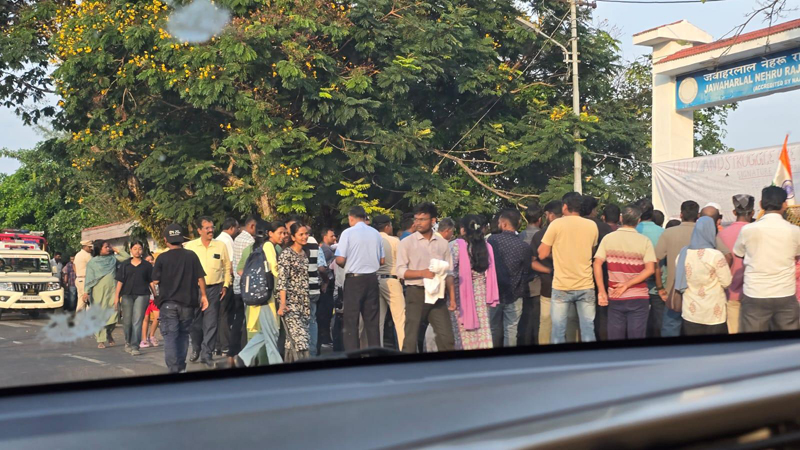
The Joint Action Forum (JAF) against the Deemed University has drawn what observers describe as first-of-its-kind public support across the Andaman & Nicobar Islands, highlighting student’s demand for continuity with Pondicherry University.
The March 2024 notification declaring the Netaji Subhash Chandra Bose Institute of Higher Learning a deemed-to-be university was, at least on paper, a statutory exercise under Section 3 of the University Grants Commission Act. The Gazette spoke. The seal was affixed. The law, one assumed, had taken its course.
What followed, however, has been less a routine academic transition and more a period of sustained public debate. While some stakeholders welcomed the move as a step toward institutional autonomy and local academic expansion, others expressed reservations about both timing and process.
The legal position remains clear. A notification issued by the Ministry of Education under the Act continues to operate unless formally withdrawn or struck down by a court. Political commentary or public protest does not, in itself, suspend statutory validity.
Yet the core of the present unease lies less in legality and more in expectation. Several students, speaking on condition of anonymity, have expressed a specific concern, at the time of admission, the prospectus indicated affiliation with Pondicherry University. Many say they chose the institution considering the ranking, perceived credibility and the assurance associated with a central university. The subsequent mid-course announcement of deemed university status, they argue, altered the academic framework on which their decision was based.
Their position has, in recent weeks, become more explicit. A number of students now say they would prefer to remain affiliated only with Pondicherry University for the duration of their course, rather than transition to a deemed university system midway. Their concern is shaped not only by perception, but also by experience of the past.
Some JNRM alumni recall earlier periods when the college in the Islands was affiliated with Punjab University. During that time, delays in the declaration of examination results were reported, sometimes stretching over several months. Such delays affected applications for higher studies, employment opportunities and professional examinations. These memories, passed down through parents, teachers and academic circles, continue to influence student attitudes toward sudden institutional transitions.
The anxiety also manifested in prolonged campus action. Student’s strike activities continued for nearly a fortnight for reflecting the depth of concern among those directly affected. It is worth noting that political representatives had reportedly been writing to the authorities and the Ministry of Education on the issue for the past couple of years. Many observers now feel that if clearer instructions and explanations had been placed in the public domain at an earlier stage, the situation might not have escalated to the point of extended protest.
Public sentiment, at moments, extended beyond campus. On a recent day of protest, much of the archipelago reportedly observed a voluntary shutdown close to 98% from North Andaman- Diglipur through Rangat, Mayabunder, Billiground, Kadamtala, Baratang, Jirkatang and South Andaman to Bambooflat, Ferrargunj, Stewartgunj, Wimberlygunj, Little Andaman, Shaheed Dweep, Swaraj Dweep, Kamorta and Campbell Bay in Great Nicobar( the southernmost island of the country).
Government STS, AC and non-AC mini buses, including JBM and GoGo services, were pressed into service in Sri Vijaya Puram, but there were hardly any commuters, possibly due to the unscheduled nature of services or because many residents chose to stay home voluntarily in solidarity. Government meetings, examinations and private functions went on uninterrupted. Tourists, though deprived of a day’s routine activity, did not encounter untoward incidents. Personnel in uniform were reported to be polite, and protesters conducted themselves peacefully, observing law and order. Air passengers also did not face major difficulty in reaching their hotels during the day.
This unease is also linked to a broader administrative context. In recent years, several young leaders across platforms have stepped down from positions of responsibility, both recently and in the past, citing frustration after facing public criticism over unresolved civic concerns. Issues such as water supply, electricity reliability, airport parking and entry fees, roads, the Chatham bridge issue and boat connectivity have periodically triggered demonstrations. When basic infrastructure becomes a recurring source of grievance, public confidence in decisions tends to weaken.
None of this alters the statutory position of the notification concerning the Netaji Subhash Chandra Bose Institute of Higher Learning. It remains operative unless formally rescinded or judicially invalidated. The question before the administration is therefore not one of legality alone, but of communication, transition management and trust-building.
Educational reform, particularly in remote territories, demands more than procedural compliance. It requires transparency, a clear roadmap and sensitivity to the expectations of those already enrolled. Students enrol with certain assumptions; institutions evolve with broader objectives. Bridging that gap calls for dialogue rather than declaration.
In higher education, legality establishes authority. Consent and clarity sustain confidence.
In a significant development amid continuing student protests, Bishnu Pada Ray, Member of Parliament from the Andaman & Nicobar Islands, has met Union Education Minister Dharmendra Pradhan personally also & written to Prime Minister Narendra Modi and Union Home Minister Amit Shah on 9th February and 16th February, 2026, seeking intervention on the Deemed University issue.
The letters come at a time when sections of students across the Islands have been staging protests, expressing concern over academic continuity and the implications of the transition to a deemed-to-be university structure. The developments have triggered public debate among students, parents and education stakeholders.
According to sources familiar with the matter, the MP has conveyed the concerns raised by students and sought clarity and appropriate action from the Union Government. The correspondence reportedly highlights the need to address anxieties related to affiliation, recognition of degrees and the overall academic future of students in the Islands.
The issue gained prominence following the notification declaring the institute a deemed-to-be university. While the move was presented as an administrative step under the relevant provisions of the University Grants Commission framework, it has since generated differing opinions within the local academic community.
Students participating in the protests have called for assurances on continuity with existing university arrangements and have sought greater transparency regarding the transition process. Parents and sections of civil society have echoed similar concerns, emphasising the importance of stability in higher education.
With the matter now taken up at the highest levels of the Union Government, attention has shifted to the Centre’s response. Any policy decision or clarification from the Prime Minister’s Office or the Ministry of Home Affairs could shape the future course of the issue.
For the present, stakeholders in the Islands appear to be awaiting an official response, hoping for a resolution that addresses student concerns while ensuring institutional stability. Until then, uncertainty continues to define the discourse around higher education in the Union Territory.
Author’s note: The writer is a freelance Journalist who made several visits to the protest site to understand the prevailing public sentiment spoke to several students and few parents. This write-up is non-political in intent and is based on direct observations and reports from across the islands.