
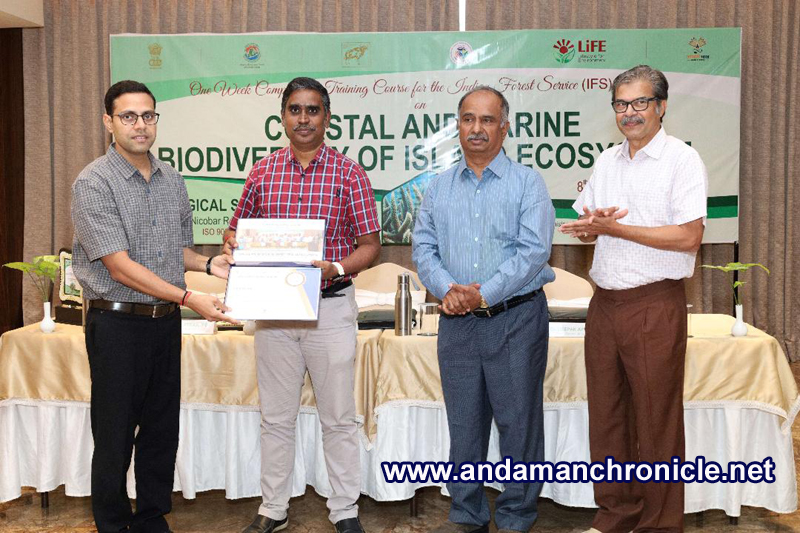
Sri Vijaya Puram, Dec. 17: The one-week compulsory training course on “Coastal and Marine Biodiversity of Island Ecosystem” for the Indian Forest Service (IFS) Officers conducted by the Zoological Survey of India, Andaman & Nicobar Regional Centre during 8th – 12th December, 2025 concludes. The training programme is sponsored by the Ministry of Environment, Forest and Climate Change (MoEFCC), Government of India. A total of 21 IFS officers from various states including Jharkhand, Punjab, Himachal Pradesh, Andhra Pradesh, Bihar, Manipur, Orissa, Uttar Pradesh, Telangana, Rajasthan, Karnataka, Chhattisgarh, Gujarat and Haryana participated in the programme. The valedictory function was held on 12th December, 2025 at Sea Shell Coral Cove, Minnie Bay. Dr. R.S.C. Jayaraj, IFS, Former Principal Chief Conservator of Forests (PCCF), A&N islands was the Chief Guest and Dr. Deepak Apte, Director – ARC (Ecology & Conservation), DES Pune University, Pune & Former Director, Bombay Natural History Society, Dr. S. Dinesh Kannan, IFS, Chief Conservator of Forests (Wildlife) (CCF), Department of Environment and Forests, A & N Islands was the special guests.
The course has been designed to include both classroom sessions and practical field exercises, aimed at equipping officers with in-depth understanding of coastal and marine biodiversity of island ecosystems. Four technical sessions comprising eight expert lectures were conducted, wherein eminent resource persons delivered insightful talks on sustainable management, conservation practices, and ecosystem-based approaches. In addition to classroom sessions, field visits were organized to provide participants with hands-on exposure to the unique ecosystems of the Andaman and Nicobar Islands. As a part of field training, the participants visited Rani Jhansi Marine National Park; Mahatma Gandhi Marine National Park, Baratang Mangroves & Lime Stone Caves, Intertidal areas of Burmanella, and Chidiyatappu Biological Park.
Dr. R.S.C. Jayaraj in his valedictory address highlighted about the training programme which was designed around three fundamental pillars of conservation management. He concluded by expressing his satisfaction with the training programme, the learning environment, and the exposure provided, and hoped that participants would return with lasting memories and practical insights gained during the course.
Dr. Deepak Apte in his address emphasised that capacity-building programmes on coastal and marine biodiversity should not be limited to national or regional institutions alone, but also be organised at the state forest department level. He noted that state-level training programmes allow for more focused deliberations on region-specific issues, thereby strengthening on-ground conservation and management. He appreciated the efforts of the organisers and expressed his pleasure in being part of the programme.
Dr. S. Dinesh Kannan in his address congratulated all participants on the successful completion of the training programme and appreciated their efforts in attending the course away from routine responsibilities. He highlighted that exposure to the unique island ecosystem of the Andaman and Nicobar Islands provides valuable learning, as island systems differ significantly from mainland forest and coastal ecosystems. He emphasised the importance of first-hand exposure to National Park and coastal ecosystem management practices, including interaction with field staff, technical sessions, and panel discussions. Appreciated the panel discussion, noting that it provided diverse perspectives on conservation challenges and management strategies adopted in different states, which can guide future actions in island ecosystems. He concluded by wishing all participants a safe and pleasant journey and expressed hope that the knowledge gained would be applied effectively in their respective postings.
The session concluded with a vote of thanks, followed by the distribution of certificates to the trainees by the Chief Guest and Special Guest.