
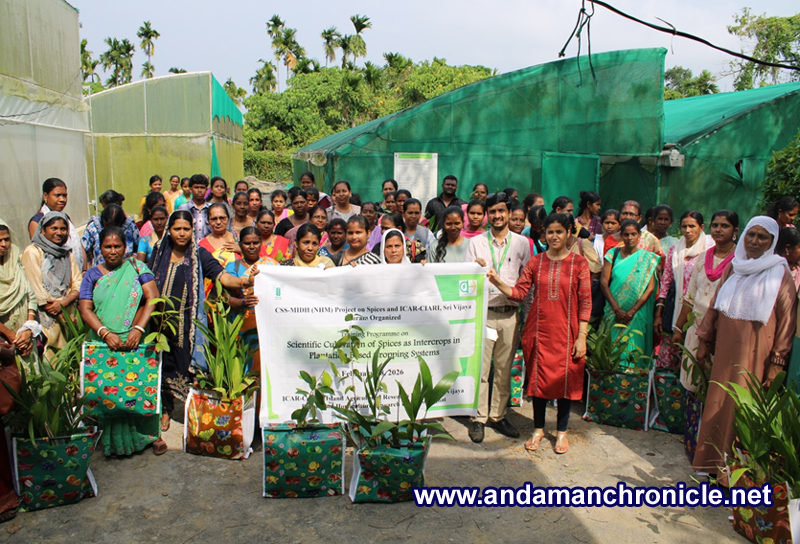
Sri Vijaya Puram, Feb 20: ICAR-Central Island Agricultural Research Institute, Sri Vijaya Puram conducted a training programme on ‘Scientific Cultivation of Spices as Intercrops in the Plantation Based Cropping Systems’ on February 18, 2026 under CSS-MIDH (NHM) Project on Spices and AICRP on Plantation Crops.
Agriculture in the Andaman and Nicobar Islands is largely characterized by plantation crops such as coconut and arecanut. The wide spacing of these plantations offers significant opportunities for cultivating high-value intercrops, particularly spices, which thrive under the region’s favorable agroclimatic conditions. Despite this potential, many farmers remain unaware of scientific methods for cultivation, harvesting, and post-harvest handling of spices, resulting in low yields and inconsistent quality. To address this gap, a training programme was organized for the farming community, with special focus on women-led self-help groups.
During the inaugural session, Dr. Jai Sunder, Director (A), interacted with participants and expressed satisfaction at their enthusiastic participation. He encouraged them to seek guidance from scientists to resolve challenges in crop, livestock, and fishery sectors. Dr. Ajit Arun Waman, Senior Scientist and Course Director, delivered a presentation on scientific spice cultivation and demonstrated cinnamon harvesting using the Dweep CinnRub tool developed by ICAR-CIARI. Participants also viewed educational films on the harvesting and post-harvest handling of spices.
During the field visits, participants were taken to the Field Distillation Unit wherein essential oil extraction was demonstrated. Further, participants visited Horticultural Plants Propagation Unit wherein they witnessed nursery raising of perennial spices. Protected cultivation of woody pepper was shown to them wherein possibilities of promotion of this novel spice were discussed. Cultivation of Malabar tamarind using grafts of improved varieties viz. Dweep Agrim and Dweep Vishal, gravity fed drip irrigation and adoption of weed mat were showcased. Further, importance of soil and water conservation measures, terracing and shade provision to young plants was explained to the farm women. Considering the changing climatic conditions, importance and relevance of foliage-based spice- Tejpat, was discussed during the programme. Participants were also educated about Dweep Tej-1, the first ever improved variety of tejpat developed in the country.
At the Horticulture Research Farm, Sippighat, Dr. Pooja Bohra, Senior Scientist and Course Coordinator, highlighted the importance of intercropping under coconut and arecanut plantations. She showcased CIARI-developed intercropping models and addressed stakeholders’ queries. Participants also visited high-density cinnamon plantations and the World Coconut Germplasm Centre.
To give impetus for this, planting material of various spices including cinnamon, woody pepper, lemongrass, arecanut ‘Samrudhi’ were distributed to the participants. Participants were also shown various value-added products developed from local resources viz. culinary paste from mango ginger and syrup of Andaman Kokum, both of which were developed at CIARI. The training was conducted under the CSS-NHM Project on Spices funded by Directorate of Arecanut and Spices Development, Kozhikode, Kerala. A total of 84 stakeholders, mainly the members of the women SHGs of South Andaman Island, were mobilized and coordinated by Fr. Michael Raj, DISHA, Caddlegunj.