
How Digital Addiction is Rewiring the Brain and Weakening Human Cognition
By Dr. Ajai Kumar Sonkar
We often celebrate technological advancement as a hallmark of human progress. Smartphones have connected the world, made information accessible, and transformed communication. Yet, beneath this digital revolution lies a growing crisis that is silently affecting millions of young minds. The very device designed to empower humanity is increasingly becoming a source of cognitive decline, attention disorders, emotional instability, and behavioral addiction.
As a scientist, I believe that the greatest threat posed by smartphones is not merely the time they consume, but the way they alter the brain itself.
The Brain Was Not Designed for Endless Reels
The human brain evolved over hundreds of thousands of years in an environment where rewards were scarce and effort was necessary for survival. Every achievement required patience, concentration, and persistence.
Today, social media platforms provide a completely different environment. Short-form videos, commonly known as reels, bombard the brain with an endless stream of novelty. Every swipe introduces a new face, a new joke, a new song, a new emotional trigger, or a new surprise.
According to renowned scientist Dr. Ajai Kumar Sonkar, this constant stimulation overwhelms the brain’s natural reward system. The brain begins to crave instant gratification rather than sustained effort. Activities that once brought satisfaction, reading a book, studying, engaging in conversation, or solving a problem, start to feel boring in comparison.
Dopamine: The Chemical Behind Digital Addiction
Every reel delivers a small burst of dopamine, a neurotransmitter associated with reward and motivation. The problem is not dopamine itself; it is the unnatural frequency with which these rewards are delivered.
When a young person spends hours scrolling through reels, the brain receives hundreds or even thousands of micro-rewards in a single session. Over time, the reward system adapts by becoming less sensitive.
Dr. Sonkar explains that this process is similar to what occurs in other forms of addiction. The brain starts demanding more stimulation to achieve the same level of satisfaction. As a result, users spend longer periods on their phones while deriving less genuine pleasure from real-world experiences.
The Collapse of Attention Span
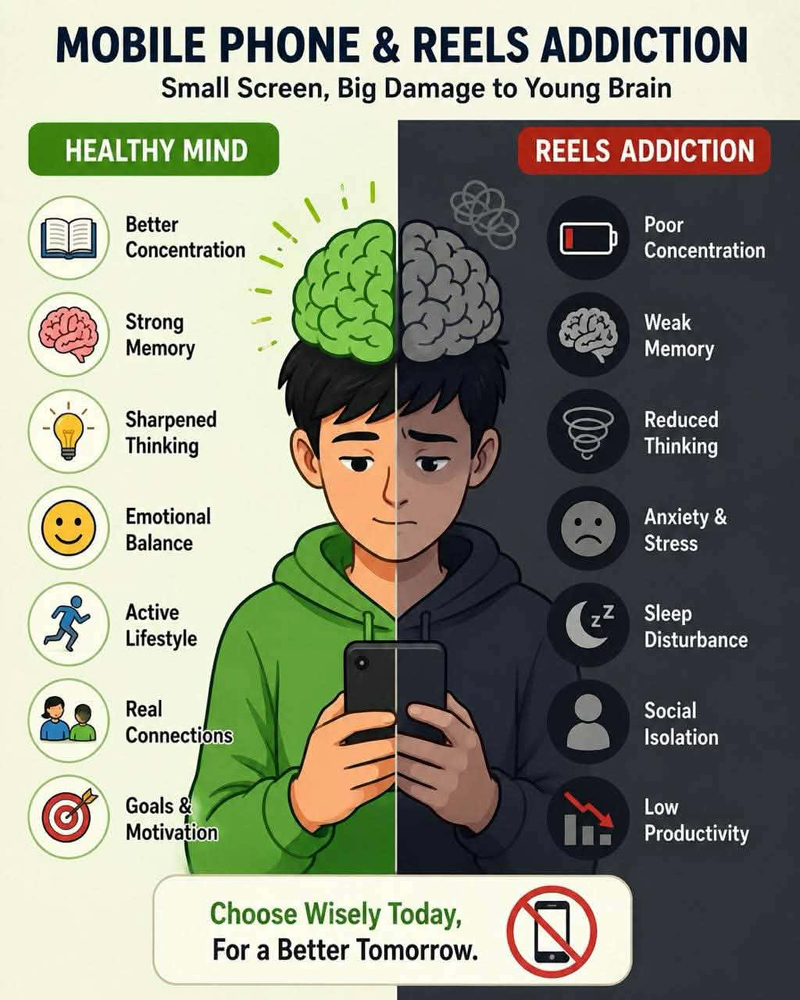
One of the most alarming consequences of reel addiction is the deterioration of attention span.
Most reels last between a few seconds and a minute. The brain becomes accustomed to rapidly changing information and immediate rewards. Consequently, activities requiring prolonged focus become increasingly difficult.
Students often report that they can spend three hours scrolling on social media but struggle to concentrate on a textbook for fifteen minutes.
According to Dr. Sonkar, the brain gradually loses its capacity for deep attention. Instead of processing information carefully, it becomes conditioned to skim, swipe, and move on. This phenomenon may significantly impair academic performance, creativity, and critical thinking.
The Death of Deep Thinking
Human civilization was built by individuals capable of sustained thought. Scientific discoveries, philosophical insights, literature, and technological innovations all emerged from deep concentration.
Reel addiction works in the opposite direction.
Rather than encouraging reflection, it promotes constant distraction. Young minds are exposed to thousands of fragmented pieces of information every day but are rarely given the opportunity to think deeply about any of them.
Dr. Sonkar warns that excessive digital stimulation may produce a generation that is highly informed yet poorly reflective, capable of consuming information rapidly but struggling to analyze, interpret, and synthesize knowledge.
Memory Under Attack
Memory formation requires attention. When attention is fragmented, memory suffers.
A student may spend hours online and encounter hundreds of facts, images, and messages. However, very little of this information is retained because the brain never engages deeply enough to transfer it into long-term memory.
Researchers have increasingly observed that constant multitasking and digital distraction interfere with learning efficiency.
Dr. Sonkar notes that the brain functions much like a muscle. If it is trained to switch tasks every few seconds, its ability to maintain and store information weakens over time.
Anxiety, Depression, and Emotional Instability
The effects are not limited to cognition.
Many social media platforms expose young users to unrealistic lifestyles, edited appearances, and carefully curated success stories. Constant comparison can generate feelings of inadequacy, loneliness, and low self-esteem.
Furthermore, the endless cycle of likes, comments, and notifications creates emotional dependency.
According to Dr. Sonkar, many young people unknowingly tie their self-worth to digital validation. When that validation decreases, anxiety and emotional distress often follow.
This phenomenon has contributed to rising concerns regarding mental health among adolescents and young adults worldwide.
Sleep Deprivation: An Invisible Crisis
The human brain performs critical maintenance functions during sleep. Memory consolidation, emotional regulation, and neural repair all depend upon adequate rest.
Unfortunately, smartphones frequently accompany young people into their bedrooms.
Late-night scrolling delays sleep and exposes the eyes to blue light, which suppresses melatonin production and disrupts the body’s natural sleep cycle.
Dr. Sonkar emphasizes that chronic sleep deprivation can impair concentration, weaken memory, reduce emotional resilience, and negatively affect overall brain development.
The Loss of Human Interaction
Another overlooked consequence is the decline of face-to-face communication.
Throughout history, human intelligence evolved through social interaction. Conversations taught empathy, emotional understanding, and complex communication skills.
Today, many young people spend more time interacting with screens than with other humans.
According to Dr. Sonkar, this shift may weaken interpersonal skills and reduce opportunities for meaningful social learning. Digital communication cannot fully replace the richness of direct human interaction.
Reclaiming the Human Brain
The solution is not to abandon technology but to use it wisely.
Dr. Sonkar recommends several practical measures:
• Establish daily screen-time limits.
• Avoid smartphones during meals and family interactions.
• Keep phones out of bedrooms during sleep.
• Schedule regular periods of digital detox.
• Encourage reading, outdoor activities, and physical exercise.
• Practice focused work sessions without notifications.
• Cultivate hobbies that require sustained attention and creativity.
A Warning for the Future
Humanity’s greatest achievements emerged from minds capable of patience, concentration, and deep thought. If the current trajectory of digital addiction continues unchecked, society may face a gradual erosion of these essential cognitive abilities.
Renowned scientist Dr. Ajai Kumar Sonkar cautions that while smartphones are remarkable tools, they must remain servants of human intelligence rather than its masters. The future of civilization depends not merely on the technologies we create, but on our ability to preserve the cognitive strengths that made those creations possible.
The battle for the future may not be fought in laboratories or boardrooms. It may be fought in the minds of young people deciding whether to swipe once more, or to reclaim their attention, their creativity, and their humanity.