
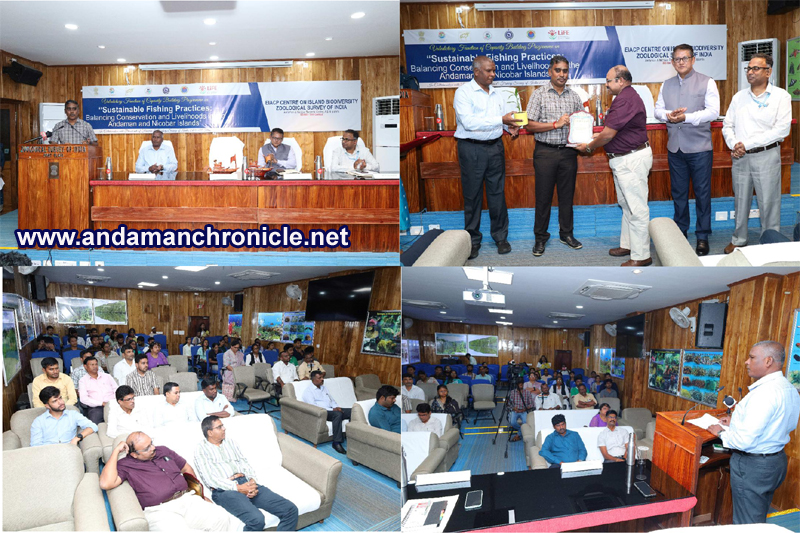
Sri Vijay Puram, Jan 25: The EIACP Centre on Island Biodiversity, Zoological Survey of India, Andaman & Nicobar Regional Centre in collaboration with the Directorate of Fisheries and Fishery Survey of India conducted two- week Capacity Building Programme on “Sustainable Fishing Practices: Balancing Conservation and Livelihoods in the Andaman and Nicobar Islands”. The Valedictory function of the two-week Capacity Building Programme held on 24th January, 2026 at ZSI. Dr. S. Dinesh Kannan, IFS, Chief Conservator of Forests (Wildlife), Department of Environment and Forests, A&N Islands was the Chief Guest and Dr. Jai Sunder, Director-in-Charge, ICAR-Central Island Agricultural Research Institute, A&N Islands, Mr. B. Balanayak, Mechanical Marine Engineer, Fishery Survey of India, A&N Islands was the special guests.
The Capacity Building programme conducted during 7th – 24th January, 2026 across seven strategic locations Panighat, Guptapara, Junglighat, Dignabad, Wandoor, Port Blair and Baratang with the objective of strengthening sustainable fisheries management in the island ecosystem. A total of 372 participants, including fishermen, students from Pondicherry University and coastal community leaders, were trained through a series of intensive technical lectures and hands-on training sessions to the unique ecological & socio-economic importance of the Andaman & Nicobar Islands. Two specialized hands-on modules focused on Navigation and Seamanship at Junglighat Fishing Harbour and Tuna Fishery Resources in the Indian Exclusive Economic Zone (EEZ) through demonstrations led by the Fishery Survey of India.
Dr. S. Dinesh Kannan, in his address, praised the field-oriented approach that brought training directly to students and fishing communities and thanked the EIACP Centre on Island Biodiversity and Zoological Survey of India, A & N Islands for organising the successful two-week capacity building program. He highlighted that conservation and sustainability as the fundamental tenets of fisheries management and used the “golden egg” analogy to describe sustainability while warning against the perils of overexploitation.
Dr. Jai Sunder, in his speech, commended the Zoological Survey of India and EIACP teams for conducting a highly pertinent capacity building program for students, fishermen, and other important players. He emphasised that self-sufficiency and economic expansion must coexist with sustainability and conservation. He drew attention to the increasing effects of climate change, such as the loss of biodiversity, rising sea surface temperatures, and extreme weather occurrences. He called for creative and ecological solutions, pointing out the difficulty of supplying projected food demands by 2050 without increasing land area.
Mr. B. Balanayak, in his speech underlined the significance of striking a balance between the preservation of aquatic biodiversity and the stability of fishing communities’ means of subsistence, emphasising that fisheries sustainability is a shared duty owed to future generations. He emphasised how the Fishery Survey of India’s scientists actively participated as resource persons, enhancing institutional cooperation and information exchange.
Earlier, Dr. C. Sivaperuman, Additional Director, ZSI & Programme Coordinator, EIACP Centre on Island Biodiversity gave a brief overview of the program’s concept and goals, which are to support sustainable fishing methods, the preservation of marine biodiversity, and the security of fishing communities’ means of subsistence. In addition to highlighting the significance of implementing best practices and responsible fishing methods, he underlined the necessity of tackling pressing issues including overfishing, habitat deterioration, and marine pollution. He added that the program looked at community-driven solutions and policy interventions for sustainable fisheries management. He also acknowledged the continuous work of the EIACP team & resource persons and expressed gratitude to the Ministry of Environment, Forests, and Climate Change, Government of India, Directorate of Fisheries, and Fishery Survey of India for their cooperation and support in making the program a success.
At the concluding of the function the participants received their certificates from the chief guests and special guests.