
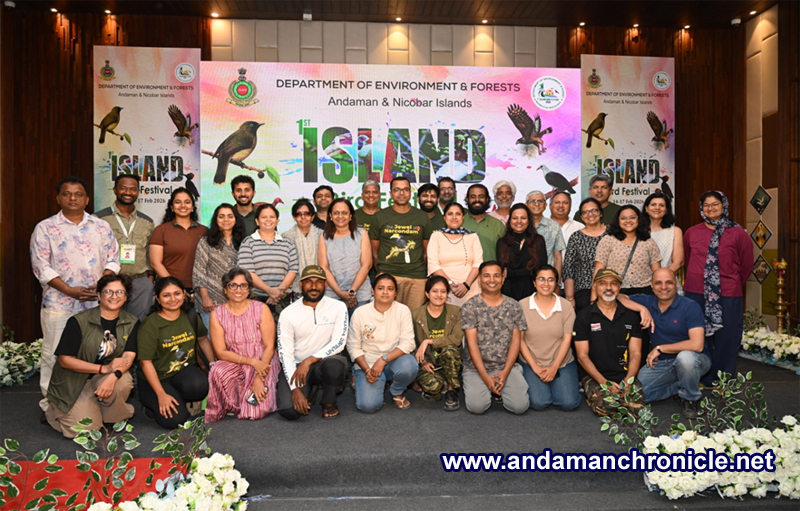
Sri Vijaya Puram, Feb. 19: The Andaman & Nicobar Administration concluded the inaugural 1st Island Bird Festival (February 14–17), a transformative event that highlighted the region’s extraordinary avian biodiversity and potential for sustainable ecotourism. The four-day event brought together a global community of birders, researchers, and photographers to celebrate the archipelago’s unique avifauna. A total of 31 delegates from 9 States and 6 local participants from Andaman & Nicobar Islands were chosen as delegates for the event. The event was supported by the Andaman Avians club.
The festival was officially inaugurated on Feb. 14 by chief guest Dr. Chandra Bhushan Kumar, IAS, Chief Secretary, A&N Administration, accompanied by Shri Sanjay Kumar Sinha, PCCF at Chidiyatapu. The ceremony blended cultural heritage with conservation, featuring a Nicobari dance, Bird dance and conservation-focused skit by the trainees of Forest Training Institute highlighting the protection of the Edible-nest Swiftlet.
Over four days, participants engaged in field trails across hotspots like Mahatma Gandhi Marine National Park, Mount Manipur National Park, Stewartgunj wetlands, Kalatang, Chidiyatapu Biological Park, Bada Balu, Ograbraj and Sippighat. The excursions were highly successful. During the field visits, delegates recorded more than 130 species with a strong mix of endemic birds and other special island species. Among the endemic birds, highlights included the Andaman Woodpecker, Andaman Bulbul, Andaman Drongo, Andaman Coucal, Andaman Serpent Eagle, Andaman Crake, Andaman Flowerpecker, Andaman Treepie, Andaman Shama, Andaman Cuckooshrike, Andaman Green Pigeon, and the striking Andaman Teal—the true icon of island endemism. Along with these, delegates also enjoyed sightings of many other birds, such as White-bellied Sea Eagle, Black Winged Stilt, Common Snipe, Grey-Headed Lapwing, Oriental Skylark, Eyebrowed Thrush and a variety of winter migrants and shorebirds seen around wetlands and coastal areas, adding richness and variety to every trail.
Dr. Dhananjay Mohan spoke on “Developing bird-based ecotourism: Lessons from Uttarakhand,” offering practical insights on how conservation and tourism can support each other when managed responsibly. Wildlife filmmaker Dhritiman Mukherjee shared “My Experience with Birds,” inspiring participants with stories of patience, field craft, and seeing nature through a storyteller’s lens.
Dr. Rajah Jayapal delivered a deeply informative session on “Population Monitoring of Island Birds: Principles & Methods,” building understanding on how science supports long-term protection.
Shri Shashank Dalvi spoke on the migratory patterns of birds to the Andaman & Nicobar Islands, linking the Islands to global flyways and seasonal movement. Dr. P. Pramod added two powerful sessions—one on endemic birds: the unique avifauna of A&N Islands, and another on “Acoustic Communication in Birds: the science of bird sound,” helping delegates interpret calls and understand how sound shapes bird behaviour and survival.
Along with terrestrial birding, pelagic birding was introduced which offers an opportunity to observe seabirds and ocean-going species in their natural marine environment—an experience that very few places in India can offer. In addition, star gazing session was organized, connecting participants not only to wildlife but also to the larger wonders of nature—helping us appreciate these Islands as an ecosystem of land, sea and sky, and in day and night.
The festival concluded on February 17 with a valedictory function presided over by chief guest, Dr. Dhananjai Mohan. Participants shared heartfelt experiences, and prizes and certificates were distributed to participants and team leaders to celebrate their contribution to the event.
The festival successfully linked the Islands’ rich cultural heritage with the urgent need for habitat preservation. By fostering a shared commitment among locals and visitors, the event has set a new benchmark for eco-tourism in the region.