
Indian Armed Forces support the Wildlife Institute of India’s dugong research in the Andaman and Nicobar Islands
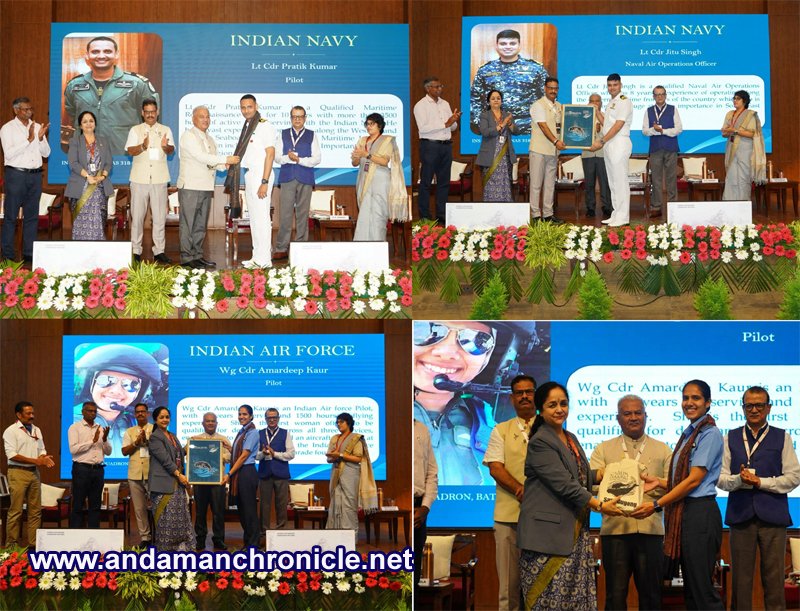
Sri Vijaya Puram, Oct. 13: At the 37th Annual Research Seminar of the Wildlife Institute of India (WII), Dehradun, on 21st September, 2026 three officers of the Indian Armed Forces were felicitated for their valuable contributions to dugong research in the Andaman and Nicobar Islands. Dugong sightings reported during routine operational missions have provided valuable scientific records from remote, difficult-to-survey waters.
Since 2016, WII’s CAMPA–Dugong Recovery Programme, led initially by Dr K. Sivakumar (former Scientist, WII) and subsequently by Dr J. A. Johnson (Scientist F, WII), has engaged the Armed Forces through the Dugong Monitoring Program (DMP). Initiated by Dr Swapnali Gole and Mr Sumit Prajapati, this citizen-science initiative encourages seafarers to report dugong sightings, expanding knowledge of the species’ distribution and supporting conservation efforts across the Islands.
The felicitated officers were Wing Commander Amardeep Kaur of the Indian Air Force (2233 Squadron, Bathinda), who undertook aerial sorties with the Indian Coast Guard, and Lieutenant Commanders Pratik Kumar and Jitu Singh of the Indian Navy (INAS 318, INS Utkrosh).
They received their honours from Dr S. P. Yadav, Director General, International Big Cat Alliance; Dr G. S. Bhardwaj, IFS, Director, WII; and Dr Ruchi Badola, Dean, Faculty of Wildlife Sciences, WII, in presence of Dr G. S. Rawat, former Dean, WII; Dr Bivash Pandav, Scientist G and Research Coordinator, WII; and Dr J. A. Johnson, Principal Investigator of the Dugong Recovery Programme.
WII acknowledged the support of the Andaman and Nicobar Command and approximately 20 personnel from the Navy, Coast Guard, Air Force and Army. The Institute also recognised the continued financial support of the CEO-CAMPA and Wildlife Division, Ministry of Environment, Forest and Climate Change.
This partnership demonstrates how observations made during defence operations can contribute to scientific research, strengthening efforts to protect India’s marine biodiversity.