
– By Dr. Ajai Kumar Sonkar
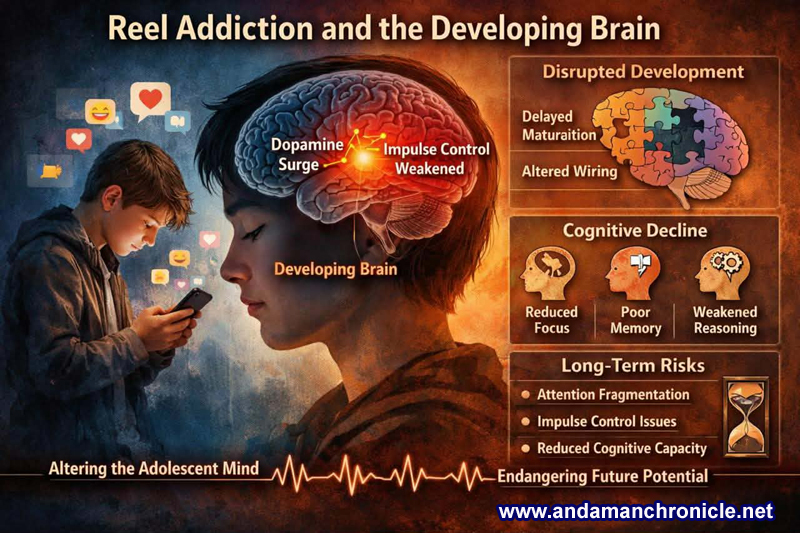
In the digital age, short-form video content, commonly known as “reels,” has become one of the most dominant forms of daily engagement, especially among teenagers and young adults. Every few seconds, a new image, new emotion, new topic, and new stimulus appears. The brain is required to disengage, reorient, process, evaluate, and react repeatedly and rapidly.
This raises a serious neuroscientific concern:
Is the human brain designed for such rapid and continuous cognitive switching? And more importantly, what happens when this pattern begins during adolescence while the brain is still developing?
Renowned scientist Dr. Ajai Kumar Sonkar says that we are witnessing an unprecedented cognitive experiment on a developing generation. “The brain evolved for depth, continuity, and reflection — not for endless micro-stimuli every few seconds,” he explains.
The Brain Is Not Built for True Multitasking
Neuroscience has consistently shown that the human brain does not truly multitask. Instead, it performs rapid task switching.
Each time a person scrolls through reels, the brain must:
•Suppress the previous stimulus
•Shift attention
•Process new information
•Evaluate emotional relevance
•Anticipate reward
This process primarily engages the prefrontal cortex, the region responsible for executive control, decision-making, impulse regulation, and sustained attention.
Research from Stanford University has shown that heavy media multitaskers tend to demonstrate:
•Reduced sustained attention
•Increased distractibility
•Lower working memory performance
Frequent cognitive switching consumes mental resources and may weaken the brain’s ability to sustain deep focus over time.
Internationally acclaimed scientist Dr. Ajai Kumar Sonkar further says that continuous digital switching conditions the brain to prefer fragmentation over continuity, making sustained intellectual engagement progressively more difficult.
Neuroplasticity: The Brain Adapts to Repetition
The principle of neuroplasticity states:
The brain reorganizes itself according to repeated behavioral patterns.
Short-form video platforms are designed to maximize novelty and unpredictability. Each swipe activates dopamine release within the brain’s reward circuitry, especially in the nucleus accumbens.
With repeated exposure:
•Neural circuits favor rapid novelty detection
•Reward pathways become hypersensitive to short bursts of stimulation
•Tolerance for slow, effortful cognition declines
The brain becomes efficient at scanning and reacting, but less practiced in sustained, reflective processing.
This is not immediate structural injury, it is adaptive rewiring.
However, Padma Shri awardee scientist Dr. Ajai Kumar Sonkar warns that adaptive rewiring during critical developmental stages may have long-term consequences. “The brain does not distinguish between healthy repetition and harmful repetition. It strengthens whatever we repeatedly practice,” he notes.
Adolescence: A Critical Window of Brain Development
A crucial scientific fact must be emphasized:
The human brain does not fully mature until approximately 25 years of age.
The prefrontal cortex, responsible for impulse control, long-term planning, and rational judgment, is among the last regions to fully develop.
During adolescence and early adulthood:
•Synaptic pruning shapes neural efficiency
•Executive control networks are still stabilizing
•Dopamine systems are highly sensitive
•Habit patterns strongly influence long-term circuitry
If excessive reel consumption begins during this developmental phase, it may not simply alter behavior, it may influence how neural networks are wired during maturation.
Repeated high-frequency stimulation may:
•Prioritize reward-seeking pathways over control pathways
•Delay or weaken executive function development
•Reduce capacity for delayed gratification
•Strengthen impulsivity circuits
In this context, addiction during development is more concerning than addiction beginning in adulthood.
Dr. Ajai Kumar Sonkar emphasizes that adolescence is a “neurobiological construction phase,” and repeated exposure to instant digital rewards may shape neural architecture in ways that persist into adult life.
When Use Becomes Addiction
There is a critical difference between casual viewing and compulsive use.
Addiction-like behavior may include:
•Inability to stop scrolling
•Neglect of responsibilities
•Sleep deprivation
•Anxiety when not using the device
•Loss of time awareness
Chronic overstimulation of dopamine reward systems may dysregulate neural balance between impulse (limbic system) and control (prefrontal cortex).
Over years, especially during developmental stages, this imbalance may become deeply embedded.
Is Permanent Brain Damage Possible?
In cases of prolonged addictive exposure, particularly during adolescence, there is biological plausibility for long-term or even persistent functional impairment.
Possible enduring effects include:
•Chronic attention fragmentation
•Reduced cognitive endurance
•Weak analytical reasoning
•Decreased ability to engage in deep work
•Persistent impulsivity
•Lower tolerance for intellectual effort
The damage, if it occurs, may not resemble stroke or trauma. Instead, it may manifest as a gradual erosion of higher-order mental functions.
When neural pathways are repeatedly strengthened over many years during developmental plasticity, they can become dominant and resistant to change.
Padma Shri awardee scientist Dr. Ajai Kumar Sonkar warns that while we may not classify it as classical structural brain damage, severe adolescent addiction may alter developmental trajectories in ways that are difficult to fully reverse. “It is not dramatic destruction,” he explains, “it is silent rewiring.”
The Real Threat to Mental Ability
The most significant danger of deep reel addiction is not dramatic neurological collapse, it is subtle cognitive weakening.
Over time, individuals may:
•Struggle to read long texts
•Avoid complex discussions
•Experience rapid boredom
•Seek constant stimulation
•Feel mentally exhausted during sustained tasks
At a societal level, widespread attention fragmentation may influence intellectual culture, academic performance, and critical thinking capacity.
The concern is not entertainment, it is conditioning.
Reversibility and Responsibility
Neuroplasticity remains a double-edged sword.
If the brain can be conditioned toward fragmentation, it can also be retrained toward depth.
Protective strategies include:
•Limiting short-form content exposure
•Encouraging long-form reading
•Practicing meditation (strengthens executive networks)
•Promoting single-task focus
•Ensuring adequate sleep
•Supporting offline social engagement
Early intervention during adolescence is particularly important, as neural development is still ongoing.
Final Scientific Perspective
A balanced scientific conclusion would be:
•Casual reel usage is unlikely to cause structural brain destruction.
•Chronic addictive use may dysregulate reward and control systems.
•Adolescents are particularly vulnerable because their brains are still developing.
•Long-term addiction during development may alter neural maturation patterns.
•The most realistic risk is enduring functional impairment of executive control and sustained attention.
The true danger lies not in technology itself, but in unchecked addictive exposure during critical developmental years.
As internationally acclaimed scientist and Padma Shri awardee Dr. Ajai Kumar Sonkar concludes:
“The human brain is extraordinarily adaptable. But what it adapts to depth or distraction, depends on repeated habit. And during adolescence, those habits may shape the architecture of the adult mind.”