
By Asheesh Podder
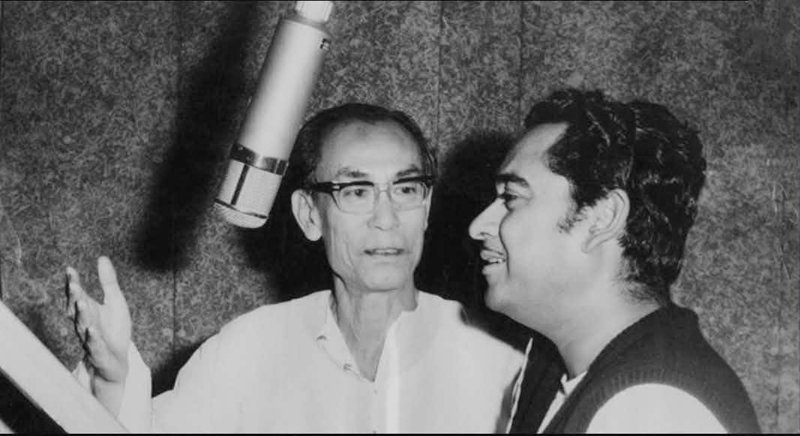
The musical association between Sachin Dev Burman and Kishore Kumar was far more than a composer-singer collaboration. It was a remarkable relationship in which a master recognised an unconventional talent’s immense potential, provided him with much-needed exposure and understood how best to utilise his distinctive voice and credentials as a singer. S. D. Burman played a pivotal role in preparing the ground for the extraordinary phenomenon Kishore Kumar would eventually become.
When Kishore made his playback debut with Ziddi in 1948, he was still finding his own identity. Influenced by K. L. Saigal, he initially attempted to emulate his idol. The often-recounted anecdote of S. D. Burman encouraging him to develop his own voice rather than imitate someone else reflects the composer’s remarkable perception. Sachin Karta (as he is popularly called within the fraternity) discerned an individuality in Kishore that needed the right guidance and opportunities to flourish.
Their association in films such as Taxi Driver, Munimji, Funtoosh, Nau Do Gyarah, Paying Guest and Chalti Ka Naam Gaadi gave Kishore valuable exposure and opportunities to demonstrate his versatility. S. D. Burman’s compositions brought out different facets of his singing—spontaneity, playful exuberance, emotional depth and effortless expression. He understood how best to utilise Kishore’s natural vocal qualities, allowing him to establish a distinctive musical identity.
Yet, despite his immense talent, Kishore’s much-deserved giant leap to the forefront of playback singing came only with Aradhana in 1969. The film became the turning point that transformed him into the defining playback voice of a generation. Its musical creation also involved R. D. Burman, particularly during his father’s illness. Nevertheless, S. D. Burman’s earlier faith in Kishore, his understanding of his potential and the exposure he had provided were significant in shaping the journey to this phenomenal breakthrough.
The depth of their musical understanding found perhaps its most poignant expression in “Badi Sooni Sooni Hai” from Mili (1975). In October 1975, just days before S. D. Burman’s death on 31 October, Kishore had rehearsed the song with the ailing composer at his residence. Shortly afterwards, S. D. Burman collapsed and was hospitalised. Despite his critical condition, he insisted that the recording proceed. Kishore recorded it without his mentor’s physical presence, under R. D. Burman’s supervision, following the musical vision they had worked out together. When the recording was played to S. D. Burman in hospital, he was reportedly moved to tears, recognising that Kishore had sung it precisely as intended. Though the exact recording date remains unverified, this episode stands as a deeply moving testament to the trust between master and disciple.
S. D. Burman did not create Kishore Kumar’s genius; rather, he discerned its potential, gave it the exposure it needed and provided the compositions and opportunities through which it could find its fullest expression. Kishore’s phenomenal rise was ultimately his own achievement, but the master’s contribution deserves enduring recognition.
There is a poignant coincidence in their remembrance: both S. D. Burman, who passed away on 31 October 1975, and Kishore Kumar, who left us on 13 October 1987, are remembered in the same month—October. Nearly twelve years separate their passing, yet their musical association continues to bring their legacies together in our hearts. As we remember S. D. Burman on his death anniversary, we also celebrate the extraordinary voice whose journey he helped shape.
Kishore Kumar went on to become an institution in himself, a voice that continues to transcend generations. And for me, he will forever remain my Guru Thakur.