
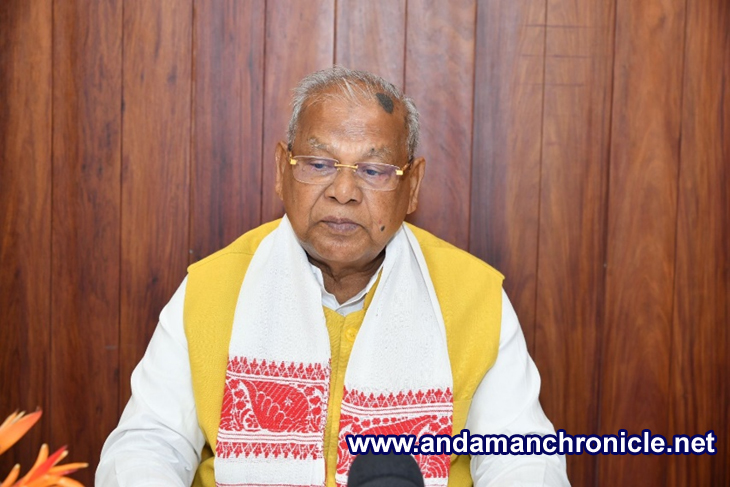
Sri Vijaya Puram, Jan. 11: The Viksit Bharat–Guarantee for Rozgar and Ajeevika Mission (Gramin) Bill, 2025 will bring in transformative reforms in providing rural livelihoods, marking a decisive shift from short-term wage support to a comprehensive, outcome-oriented rural development framework aligned with the national vision of Viksit Bharat 2047, said the Hon’ble Union Minister of Micro, Small & Medium Enterprises (MSME), GoI, Shri Jitan Ram Manjhi speaking to media persons on the sidelines of his visit to A&N Islands here today.
The Minister emphasised that greater awareness needs to be created among stakeholders and beneficiaries about the benefits of the Viksit Bharat–G RAM G Bill, 2025, which replaces MGNREGA with a more comprehensive and future-oriented rural employment framework. He said that effective communication and outreach at the grassroots level are essential to ensure that rural households, Panchayati Raj Institutions and implementing agencies clearly understand the enhanced provisions, improved employment guarantee, integrated infrastructure focus and strengthened accountability mechanisms under the new law. Creating awareness will help ensure better participation, smoother transition from the earlier scheme, and maximum utilisation of the expanded opportunities for income security and asset creation, thereby enabling the Bill to achieve its full potential in transforming rural livelihoods in line with the vision of Viksit Bharat 2047.
The Hon’ble Minister said the Bill replaces the Mahatma Gandhi National Rural Employment Guarantee Act (MGNREGA) with a strengthened statutory architecture that enhances the employment guarantee from 100 to 125 days per rural household per year, thereby significantly improving income security for rural families. By extending guaranteed employment and integrating it with long-term asset creation, the new framework seeks to ensure sustainable livelihoods rather than temporary income support.
Hon’ble Minister stated that a defining feature of the Bill is the strategic linkage of wage employment with the creation of durable rural infrastructure across four clearly defined priority verticals viz. water security, core rural infrastructure, livelihood-related infrastructure and special works aimed at mitigating the impact of extreme weather events. This integrated approach ensures that public expenditure not only provides immediate employment but also creates productive assets that support agriculture, rural enterprises and climate resilience.
Emphasising the importance of grassroots empowerment, the Minister said the Bill strengthens decentralised planning through Viksit Gram Panchayat Plans, which will be prepared locally based on village-specific needs and priorities. These plans will be digitally and spatially integrated with national systems through the Viksit Bharat National Rural Infrastructure Stack, ensuring coherence between local development initiatives and national infrastructure planning, including platforms such as PM Gati Shakti.
Detailing the funding pattern, Hon’ble Minister mentioned that the scheme adopts a calibrated cost-sharing structure of 60:40 between the Centre and States, with enhanced support of 90:10 for North Eastern and Himalayan States, and 100 per cent Central funding for Union Territories without legislatures. Provisions for additional assistance during natural disasters and emergencies, along with strengthened oversight mechanisms, will help safeguard public funds and ensure fiscal sustainability.
Explaining key operational features, the Hon’ble Minister said the Bill guarantees 125 days of wage employment in a financial year, with an aggregated 60-day no-work period during peak sowing and harvesting seasons. This provision ensures adequate availability of agricultural labour while still securing the full employment entitlement for workers during the remaining period of the year, thereby balancing the interests of both farmers and labourers. The Bill will significantly strengthen the rural economy by linking employment generation with productive asset creation, leading to higher household incomes, improved agricultural productivity and better market access.
The Minister further said the Bill establishes a clear institutional and enforcement framework to ensure coordinated and transparent implementation across national, State, district, block and village levels. A comprehensive transparency regime, incorporating AI-enabled analytics, biometric authentication, GPS- and mobile-based real-time monitoring, MIS dashboards, weekly public disclosures and mandatory social audits at least once every six months, will reinforce accountability, strengthen community participation and build public trust in the Mission.
Highlighting the role of MSMEs in strengthening rural livelihoods, the Hon’ble Union Minister said the Government is simultaneously strengthening the Udyam ecosystem to ensure that rural and village-based enterprises fully benefit from the new employment and infrastructure framework. He said Udyam Registration provides formal recognition to Micro, Small and Medium Enterprises through a simple, online and paperless process, enabling entrepreneurs to access credit, subsidies, skilling support and market linkages.
The Minister further said that initiatives such as Udyam Shreshth are aimed at enabling MSMEs to scale up, improve productivity and adopt modern technologies. Through Udyam Shreshth, the Government is supporting high-performing and growth-oriented enterprises to enhance quality standards, digitalisation and market access, including participation in national and global value chains. He said the convergence of rural employment, infrastructure creation and MSME support under initiatives such as Udyam and Udyam Shreshth will help create sustainable livelihoods, promote entrepreneurship and strengthen village economies in line with the vision of Viksit Bharat 2047.