
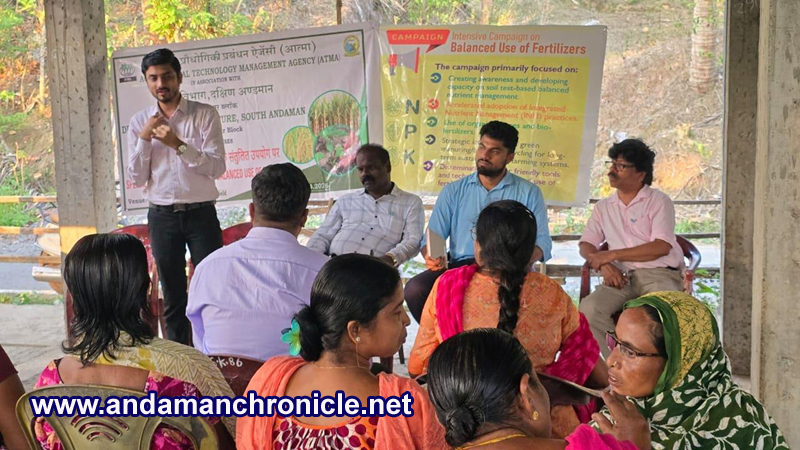
Sri Vijaya Puram, April 24: The ICAR-Central Island Agricultural Research Institute (ICAR-CIARI), Sri Vijaya Puram, Andaman & Nicobar Islands, in collaboration with the Agricultural Technology Management Agency (ATMA), organized a farmer sensitization programme on the balanced use of fertilizers at Old Bimblitan Village, South Andaman, on 23 April 2026. The programme aimed to promote sustainable nutrient management practices suited to island conditions.
Dr. M. Muruganandam, Principal Scientist and Head, Fisheries Science Division, ICAR-CIARI, highlighted the importance of integrating organic, biological, and inorganic fertilizers for enhancing crop productivity while minimizing input costs and environmental risks. He emphasized that a balanced nutrient strategy, comprising 50–60% organic inputs, 20–25% biofertilizers, and minimal or no use of inorganic fertilizers, can significantly improve soil health and sustainability in the islands.
He elaborated on the role of bio-resources such as Azolla, blue-green algae like Anabaena, and legumes (pulses) in fixing atmospheric nitrogen, thereby enriching soil fertility and reducing dependence on chemical fertilizers. The use of vermicompost and farmyard manure (FYM) as primary nutrient sources, along with biofertilizers such as Azospirillum, Rhizobium, and Phosphate Solubilizing Bacteria (PSB), Trichoderma, was strongly advocated.
Dr. Muruganandam also discussed key soil and water conservation practices, including bunding, trenching, contour farming, mulching, green manuring, cover cropping, and improved cropping systems such as mixed cropping, intercropping, and crop rotation. These practices help conserve water and minimize soil erosion, nutrient loss, and yield reduction, particularly under high rainfall conditions with the limitation of soil and other inputs prevailing in the islands.
Dr. Ajit Singh Waman, Senior Scientist (Spices), ICAR-CIARI emphasized the potential of non-conventional crops, including spices and native fruit species, which are better adapted to local soil conditions and require comparatively lower external nutrient inputs. He also informed participants about training programmes available at ICAR-CIARI on organic fertilizer production and preparation of neem-based biopesticides. He persuaded for an integrated approach to tackle existing fertilizers crisis through organic and biologic inputs besides improving cropping pattern and farming techniques.
Dr. Puneet, Scientist (Horticulture), ICAR-CIARI, highlighted the importance of balanced nutrient application for sustaining crop productivity and soil health. He emphasized right proportion of fertilizers needed to get optimum nutrient requirement of crops.
Mr. Ravi, Assistant Director of Agriculture (ATMA), briefed farmers on the status of fertilizer availability and distribution in the region and encouraged efficient utilization of available resources. He explained the need for right fertilizers, at right place and right time to enhance yield and profit. The programme was facilitated by Mr. Ravi, Ms. Baby, Assistant Technology Manager (ATMA), and their team.
Around 30 farmers, including 10 women, actively participated in the programme. The participants expressed keen interest in adopting organic and biofertilizer-based practices, if made available. Handouts on nutrient requirements and fertilizer management in the region were distributed during the meeting. Farmers were guided on suitable alternatives to chemical fertilizers and informed about availability, preparation methods, and training opportunities related to organic and biofertilizers available at ICAR-CIARI and its KVKs.