
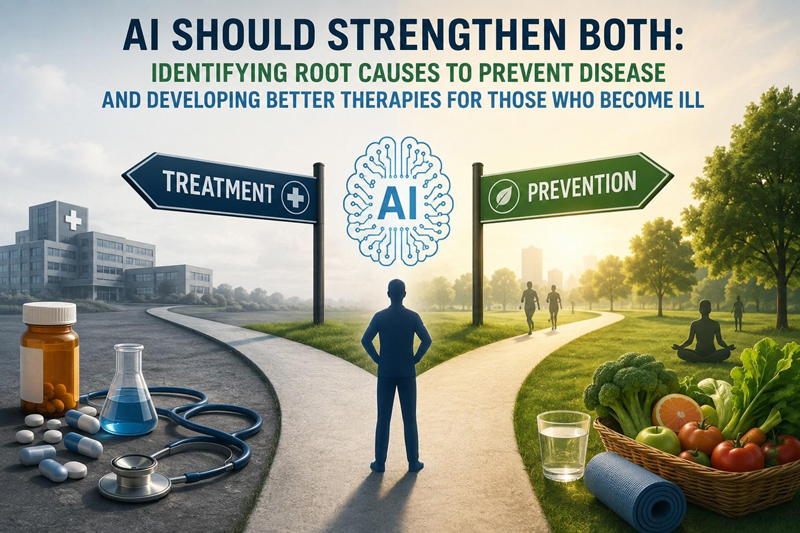
The rapid advancement of artificial intelligence (AI) has opened unprecedented opportunities in medicine. AI is already transforming drug discovery, accelerating disease diagnosis, and enabling personalized treatments that were unimaginable a decade ago. While these achievements are remarkable, they also raise a fundamental question: Are we directing AI toward solving the real problem, or merely managing its consequences?
As renowned scientist Dr. Ajai said, “We must ensure that technology does not only extend treatment capabilities but also deepens our understanding of why diseases begin in the first place.”
For millions of years, human evolution unfolded under the guidance of nature. The human genome was shaped in an environment of natural foods, diverse microorganisms, clean air, physical activity, sunlight, and close interaction with ecosystems. Long before modern science emerged, nature had established a dynamic balance that sustained human health.
The modern world, however, has dramatically altered this equilibrium. Sedentary lifestyles, ultra-processed foods, chronic psychological stress, excessive exposure to synthetic chemicals, environmental pollution, disrupted sleep cycles, and an increasingly disconnected relationship with nature have become defining features of contemporary life. At the same time, chronic diseases such as obesity, diabetes, cardiovascular disorders, autoimmune diseases, allergies, and several mental health conditions have risen to unprecedented levels.
Scientist revealed that this coincidence is unlikely to be accidental. A growing body of scientific research suggests that many chronic illnesses arise because our biology remains adapted to ancestral environments, while our lifestyles have changed at an extraordinary pace. In many cases, we are treating the symptoms of a mismatch between human biology and the modern environment rather than addressing the mismatch itself.
Artificial intelligence offers an extraordinary opportunity to change this approach.
Instead of focusing predominantly on discovering new drugs and increasingly sophisticated medical interventions, AI should also be directed toward identifying the fundamental causes of disease. By integrating genomic data, environmental exposures, nutrition, microbiome science, behavioral patterns, and population health records, AI can uncover the complex interactions that determine why diseases arise in the first place.
He said, imagine AI helping answer questions such as:
•Which modern lifestyle factors most significantly disrupt human health?
•How do environmental pollutants influence long-term disease risk?
•What combinations of diet, physical activity, sleep, and microbial exposure promote lifelong resilience?
•How can natural ecosystems and biodiversity contribute to healthier human populations?
•Which preventive interventions provide the greatest improvement in health while reducing healthcare costs?
Such knowledge could transform medicine from a predominantly reactive discipline into a truly preventive science.
This does not diminish the importance of modern medicine. Medical advances remain indispensable for treating infections, trauma, cancer, congenital disorders, and countless acute illnesses. Millions of lives continue to be saved through pharmaceuticals, vaccines, surgery, and advanced medical technologies. These achievements should be celebrated and continuously improved.
However, prevention and treatment should never be viewed as competing priorities. They are complementary pillars of healthcare. While modern medicine provides relief after disease develops, prevention seeks to reduce the likelihood that disease develops in the first place.
The future of healthcare should therefore combine the strengths of both approaches. AI should continue accelerating the discovery of life-saving therapies while simultaneously becoming humanity’s most powerful tool for understanding the environmental, biological, and lifestyle factors that preserve health.
Dr. Ajai further emphasized that “the greatest success of artificial intelligence will be when it reduces the need for treatment by preventing disease at its root causes.”
Ultimately, the greatest success of artificial intelligence may not be measured by the number of diseases it learns to treat, but by the number of diseases it helps humanity prevent.
If AI enables us to restore a healthier relationship with nature, our environment, and our own biology, it will not simply transform medicine, it will redefine the future of human health.