
Through the Humphrey Fellowship, Dr. Kaustubh Sharma explored prevention, treatment, and community-based strategies to address substance abuse and strengthen public-health responses.
By Giriraj Agarwal, SPAN Magazine, U.S. Embassy New Delhi
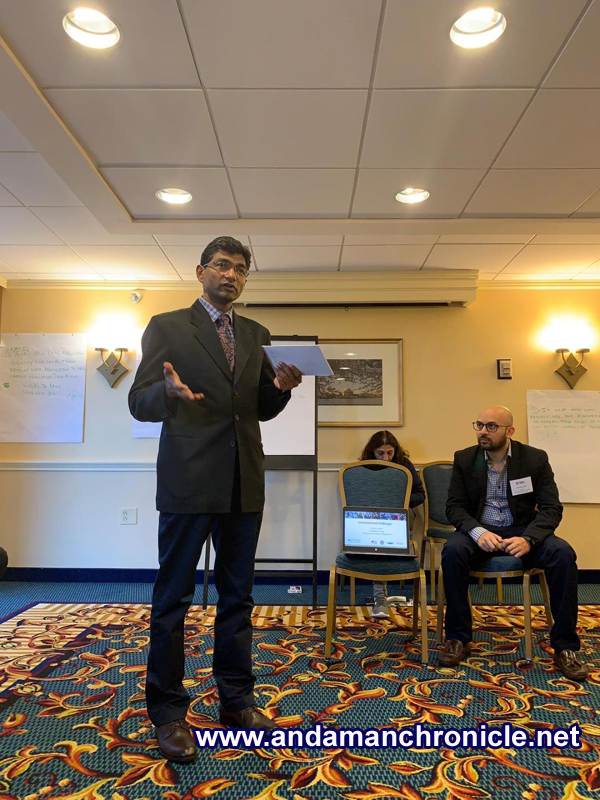
Substance abuse is a global challenge that affects families and communities, and governments increasingly recognize that long-term solutions require more than law enforcement. Prevention, treatment, and rehabilitation must work together to help people rebuild their lives.
Within this broader effort, Dr. Kaustubh Sharma, a law-enforcement professional and public-health advocate, joined the Hubert H. Humphrey Fellowship Program. Funded by the U.S. Department of State, the fellowship brings international and U.S. professionals together to share ideas and strengthen responses to pressing issues, including global health security.
“The main objectives of my fellowship were to harmonize the work of various agencies involved in controlling substance abuse, develop multi-agency coordination mechanisms, and understand the role of prevention, treatment, and rehabilitation,” Dr. Sharma explains.
Learning from U.S. approaches
During his year at Virginia Commonwealth University in 2018, Dr. Sharma studied how U.S. institutions address substance abuse across prevention, treatment, and recovery. The program exposed him to a wide range of complementary approaches.
He observed how U.S. schools conduct biannual anonymous surveys that track patterns in youth substance use, giving policymakers real-time information on emerging trends such as vaping. “Collecting this data allows policymakers to intervene at critical points in the trajectory of substance use. Without such data, we risk missing opportunities for timely intervention,” he says.
He also learned from the Virginia Foundation for Healthy Youth, which designs prevention campaigns with input from young people to ensure the messages resonate. He observed community programs and youth-led activities focused on early intervention.
A major insight for him was the role of Adult and Juvenile Drug Treatment Courts, which connect first-time offenders with treatment, provide subsidized care for those in need, and bring together health authorities, correctional services, and local governments. “Seeing how national, state, and local authorities coordinate was invaluable,” Dr. Sharma says. “Law enforcement alone cannot solve this problem. It requires a multi-layered effort.”
He also examined peer-support models such as Alcoholics Anonymous (AA), Narcotics Anonymous (NA), and SMART Recovery—a program grounded in Rational Emotive Behavioral Therapy and Cognitive Behavioral Therapy—noting how community institutions, including churches and university campuses, provide meeting spaces for these groups. “The open involvement of recovering users as mentors, along with options like AA, NA, and SMART Recovery, creates supportive pathways for individuals working toward recovery,” he says.
During his fellowship, Dr. Sharma deepened his exposure to community-based responses through professional affiliations with the Richmond Adult Drug Court and the Community Anti-Drug Coalitions of America (CADCA) in Alexandria. At the Richmond Adult Drug Court, he saw how treatment is integrated with judicial processes. At the CADCA, he learned how coalitions mobilize local stakeholders, use research-based methods, and work with policymakers to strengthen prevention efforts.
“I learned how U.S. organizations engage policymakers and legislators to support reforms, expand treatment for the underserved, and address the availability of substances, including alcohol and vapes, among youth,” he notes.
Visits to national agencies, including the Substance Abuse and Mental Health Services Administration, the National Institute on Drug Abuse, and the Drug Enforcement Administration, offered a broad view of how research, public health, and enforcement align at the national level. At the DEA, the exchange program participants also observed congressional proceedings that demonstrated how institutions contribute to policymaking.
Applying insights in India
After returning to India, Dr. Sharma began adapting several U.S. approaches in ways that suit local needs.
He introduced the SMART Recovery program, which uses evidence-based tools to help individuals manage their own recovery. A pilot project trained government psychiatrists as facilitators. “I completed the certification course myself and created standardized forms to support implementation,” he says.
He also supported the development of community coalitions inspired by CADCA. Through the Community Policing wing, outreach created safe avenues for women and children to share concerns, enabling timely interventions. Across these initiatives, Dr. Sharma highlighted early-warning assessments and community participation—practices central to the Strategic Prevention Framework he studied in the United States.
Strengthening U.S.-India collaboration
Dr. Sharma emphasizes that international cooperation is vital to addressing the trafficking of semi-synthetic opioids. “On the trafficking front, the U.S. and India face a similar onslaught of semi-synthetic opioids, especially heroin, since the area of the Golden Crescent is responsible for 80 percent of the heroin production,” he says.
He notes that active collaboration between the two countries is crucial. Strong border and customs controls, guided by risk profiling, can limit trafficking syndicates that mask the origin of goods or mislabel shipments. He adds that maritime cooperation to track suspicious vessels, and dismantling financial networks that fund trafficking operations, could further reduce the flow of illicit drugs.
Sustaining networks and collaboration
Dr. Sharma remains connected with his Humphrey cohort and faculty mentors and continues to guide Indian professionals entering the program.
Reflecting on his experience, he notes that while law enforcement plays an important role in controlling substance availability, lasting change depends on coordinated prevention, treatment, and rehabilitation supported by data and community engagement. “The most important message is to focus on prevention and invest in it,” says Dr. Sharma. “Children who can be guided now and made resilient are more likely to remain protected from trying substances, and as a society, that is the best outcome we can hope for.”