
Prayagraj, May 7: Internationally acclaimed environmental scientist and Padma Shri awardee Dr. Ajai Kumar Sonkar has drawn attention to striking satellite imagery released by NASA, describing it as “direct visual proof that the Earth is a living, breathing system.”
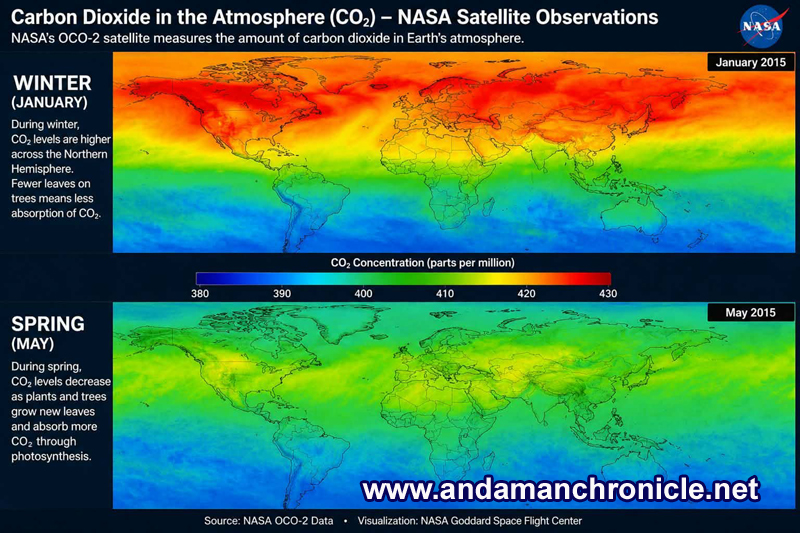
Referring to atmospheric carbon dioxide (CO₂) maps generated by NASA’s advanced satellites, Dr. Sonkar said that the color-coded imagery clearly shows high CO₂ concentrations during winter months, represented in red and orange shades. However, with the onset of spring, these zones shift toward green and blue, indicating a measurable decline in atmospheric carbon dioxide.
“This is not a symbolic statement,” Dr. Ajai Kumar Sonkar told. “It is scientific evidence that when trees regain their leaves in spring, they actively withdraw carbon dioxide from the atmosphere through photosynthesis. The planet literally inhales.”
Satellite Data Confirm Nature’s Carbon Intelligence
The observations come from missions such as OCO-2 (Orbiting Carbon Observatory-2), which measure atmospheric CO₂ with high precision across the globe.
Dr. Sonkar explained:
“During winter, especially in the Northern Hemisphere, vegetation cover is minimal. Photosynthetic activity declines, and carbon dioxide accumulates. But as soon as spring begins and new leaves appear, the concentration visibly drops. The satellite maps show this transformation dramatically.”
He further pointed out that this seasonal fluctuation aligns with long-term atmospheric measurements initiated by Charles David Keeling at Mauna Loa Observatory, which revealed the cyclical pattern now famously known as the Keeling Curve.
“Forests Are Earth’s Biological Defense System”
Dr. Sonkar emphasized that global forests absorb nearly 30 percent of human-generated CO₂ emissions annually.
“Forests are not decorative landscapes,” Dr. Sonkar said. “They are the Earth’s biological defense system against climate change.”
According to the internationally acclaimed scientist, the satellite imagery demonstrates the immense carbon sink capacity of trees. “Every spring, millions of square kilometers of forest canopy become active carbon absorbers. This is planetary-scale environmental engineering designed by nature itself.”
Restoration Is Essential, But Emissions Must Also Decline
Dr. Ajai Kumar Sonkar further revealed that restoring degraded forests could significantly reduce atmospheric carbon levels, improve air quality, regulate rainfall, and cool regional climates.
However, he cautioned:
“Tree plantation alone cannot compensate for uncontrolled fossil fuel burning. Restoration must go hand in hand with emission reduction. Protecting mature forests is even more critical than planting new ones, because old-growth ecosystems store vast amounts of carbon.”
A Message of Warning and Hope
Calling the satellite images “a wake-up call from space,” Dr. Sonkar stated:
“The Earth is showing us that it has the capacity to heal. But that healing depends on whether humanity chooses conservation over destruction.”
The Padma Shri scientist concluded that global reforestation efforts, combined with responsible industrial policies, could play a decisive role in combating global warming and air pollution.
“The science is clear,” Dr. Sonkar said. “When trees grow, carbon falls. When forests vanish, carbon rises. The choice before humanity is simple.”