
By Asheesh Poddar
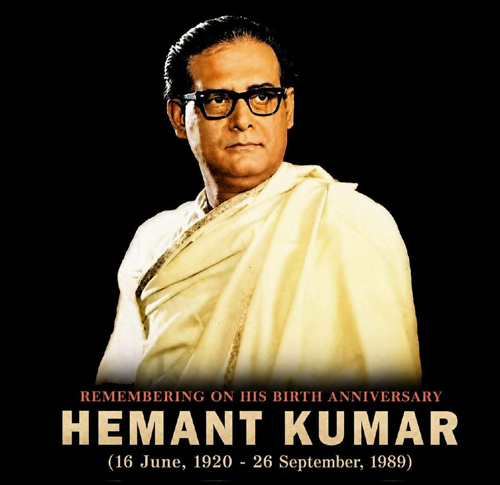
The birth anniversary of Hemant Kumar on 16 June, 2026 offers an occasion to celebrate one of the most remarkable figures in Indian music—a rare artist who attained excellence both as a singer and as a composer. Few musicians have left such a profound and enduring imprint in two distinct creative spheres.
As a singer, Hemant Kumar possessed a voice of extraordinary warmth, depth, and restraint. His renditions of songs such as “Yeh Nayan Dare Dare,” “Na Tum Humein Jaano,” “Hai Apna Dil To Awara,” “Tum Pukar Lo” and “Jaane Woh Kaise Log The” remain enduring classics, admired for their emotional sincerity and timeless appeal.
Hemant Kumar’s stature among his peers is perhaps best understood through the tributes paid to him by fellow legends. Lata Mangeshkar once famously observed:
“Listening to Hemant Da’s songs, I feel as if a sadhu is singing a bhajan in a temple.” The remark beautifully captures the spiritual purity and effortless grace that defined his singing. Composer Salil Chowdhury, one of Hemant Kumar’s closest collaborators, offered an even more extraordinary tribute: “If God could sing, He would have a voice like Hemant Kumar.” Such praise from two of the greatest names in Indian music speaks volumes about the reverence Hemant Kumar commanded within the fraternity.
Equally significant was his contribution as a composer. From the haunting melodies of Nagin to the evocative soundtracks of Bees Saal Baad, Kohraa, Anupama, and Khamoshi, Hemant Kumar demonstrated an exceptional command over melody and mood. His compositions combined simplicity with sophistication, creating music that continues to resonate decades later.
Beyond Hindi cinema, Hemant Kumar, popularly known also as Hemanta Mukherjee (Mukhopadhyay), occupies a place of singular importance in Bengali music. A distinguished exponent of Rabindra Sangeet, he brought Rabindranath Tagore’s compositions to generations of listeners through renditions marked by elegance, sensitivity, and deep understanding of the poet’s musical vision. His contribution to the popularisation of Rabindra Sangeet remains invaluable. Equally noteworthy are his modern Bengali songs, many of which have become an integral part of Bengal’s musical heritage.
Hemant Kumar’s association with Kishore Kumar adds another fascinating dimension to his legacy. The mutual respect shared by these two giants of Indian music enriched the industry, while Hemant Kumar’s work as a composer provided Kishore Kumar with several memorable musical opportunities including “Woh Shaam Kuchh Ajeeb Thi” from the Rajesh Khanna starer Khamoshi and a number of Bengali songs.
More than three decades after his passing, Hemant Kumar’s influence remains undiminished. His songs continue to be rediscovered by new generations, his compositions remain benchmarks of melodic excellence, and his Rabindra Sangeet recordings continue to inspire singers and listeners alike.
On his birth anniversary, Hemant Kumar is remembered not merely as an iconic playback singer or a distinguished music director, but as a complete musician whose achievements transcended genres and languages. He remains, in the truest sense, two musical geniuses in one—a composer extraordinaire and a voice eternal.