
In an era where anxiety, stress, and emotional exhaustion are becoming increasingly common, renowned scientist Dr. Ajai Kumar Sonkar has highlighted a scientific pathway through which individuals can retrain their brains to overcome anxiety and regain mental balance.
According to Dr. Sonkar, anxiety is not simply a psychological condition but a biological process involving complex interactions between the brain, nervous system, hormones, memories, and environmental influences.
“Anxiety is essentially an overactive survival mechanism,” Dr. Sonkar said. “The same system that helped our ancestors escape danger is now often activated by everyday situations that pose no real threat.”
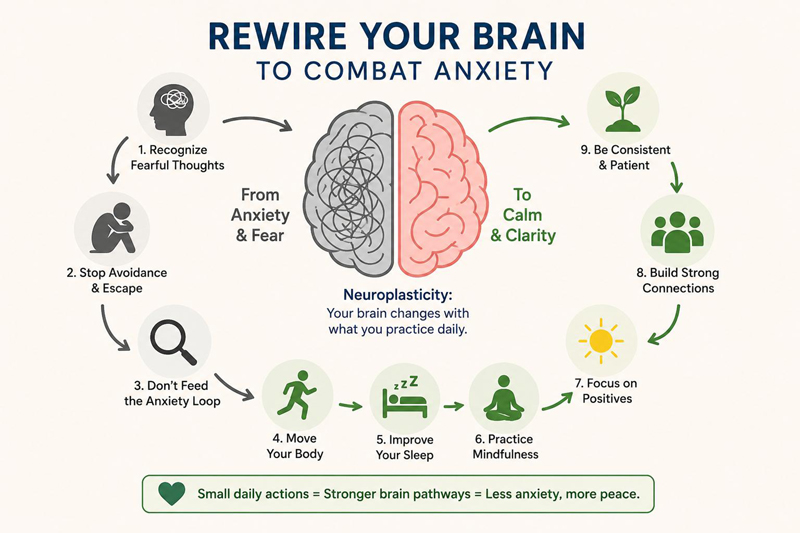
The scientist revealed that modern neuroscience has established that the human brain possesses a remarkable ability known as neuroplasticity, which enables it to reorganize and create new neural pathways throughout life.
“Many people believe that their anxious nature is permanent,” Dr. Sonkar explained. “However, the brain continuously changes according to our repeated thoughts, emotions, and behaviors. If anxiety can be learned, calmness can also be learned.”
The Brain’s Fear Circuit
Dr. Sonkar revealed that several regions of the brain play important roles in anxiety. These include the amygdala, often referred to as the brain’s alarm center; the prefrontal cortex, responsible for rational thinking; and the hippocampus, which stores emotional memories.
According to him, chronic anxiety occurs when the amygdala becomes overactive and begins identifying danger where none exists.
“The anxious brain repeatedly practices fear,” Dr. Sonkar noted. “As a result, neural pathways associated with worry become stronger over time.”
Challenging Fearful Thoughts
The renowned scientist emphasized that one of the first steps in combating anxiety is learning to question automatic fearful thoughts.
“Many anxious individuals unconsciously assume the worst possible outcome,” he said. “When we challenge these assumptions with evidence and logic, we strengthen the brain’s rational centers and reduce the power of fear circuits.”
He advised individuals to ask themselves whether there is genuine evidence supporting their fears or whether the mind is simply predicting negative outcomes.
Breathing as a Biological Tool
Dr. Sonkar further explained that anxiety is not confined to the mind; it affects the entire body.
“The nervous system responds directly to breathing patterns,” he said. “Slow, controlled breathing signals safety to the brain.”
He recommended breathing techniques that emphasize longer exhalations, which activate the body’s natural relaxation response and reduce physiological arousal.
Why Avoidance Makes Anxiety Worse
One of the most significant mistakes anxious individuals make, according to Dr. Sonkar, is avoiding situations that trigger discomfort.
“Avoidance provides temporary relief but reinforces fear in the long term,” he explained. “Each time a person avoids a situation, the brain interprets that avoidance as proof that danger existed.”
The scientist revealed that gradual exposure to feared situations is one of the most effective methods for rewiring anxiety-related neural pathways.
The Role of Exercise
Dr. Sonkar highlighted the importance of physical activity in mental health.
“Movement changes brain chemistry,” he said. “Regular exercise reduces stress hormones, promotes the release of mood-enhancing chemicals, and stimulates the growth of new neural connections.”
Even a daily walk, he noted, can contribute significantly to reducing anxiety levels.
Sleep: The Brain’s Recovery Mechanism
The Padma Shri scientist further told that sleep plays a critical role in emotional regulation.
“When people are sleep-deprived, the brain becomes more reactive to stress and less capable of rational evaluation,” he explained.
Maintaining regular sleep schedules and reducing nighttime screen exposure can substantially improve mental resilience, he added.
Mindfulness and Present-Moment Awareness
Discussing mindfulness, Dr. Sonkar said that individuals should learn to observe their thoughts rather than become overwhelmed by them.
“The goal is not to eliminate thoughts but to recognize that thoughts are not always facts,” he said.
According to him, mindfulness practices strengthen regions of the brain involved in attention, emotional control, and self-awareness.
Training the Brain to Notice Positives
Dr. Sonkar also revealed that anxious individuals often develop a strong bias toward noticing threats while overlooking positive experiences.
“The brain becomes what it repeatedly practices,” he said. “If we consciously pay attention to moments of safety, gratitude, and success, we create new neural pathways that support emotional balance.”
The Power of Human Connection
The scientist further emphasized the importance of social relationships in mental health.
“Human beings evolved as social organisms,” Dr. Sonkar said. “Supportive relationships help regulate stress responses and provide emotional security.”
Isolation, he warned, often intensifies anxiety and negative thinking.
A Message of Hope
Concluding his remarks, Dr. Sonkar stressed that anxiety should not be viewed as a personal weakness.
“Anxiety is a learned pattern of brain activity,” he said. “Through consistent practice, healthy habits, and conscious mental training, the brain can be rewired toward calmness, confidence, and resilience.”
The renowned scientist noted that every calm breath, every positive action, and every courageous step taken despite fear contributes to the formation of healthier neural pathways.
“The brain learns from repetition,” Dr. Sonkar concluded. “If it can learn fear, it can also learn peace.”