
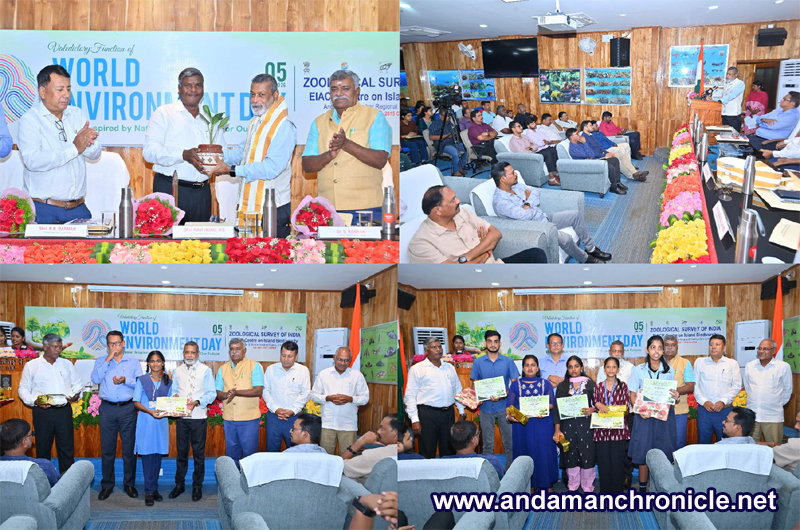
Sri Vijaya Puram, June 7: The Zoological Survey of India, Andaman & Nicobar Regional Centre and EIACP Centre on Island Biodiversity celebrated World Environment Day 2026 with a series of impactful activities culminating in a Valedictory Function on 5th June, 2026 at the ZSI. Shri. Ravi Horo, IFS, Principal Chief Conservator of Forests (Wildlife), Department of Environment and Forests, A & N Islands was the Chief Guest of the valedictory function and Prof. Nagendra Sarma, Principal, Andaman Law College, Dr. Jai Sunder, Director, ICAR-Central Island Agricultural Research Institute, A&N Islands, Prof. S. Kannan, Chairperson, School of Energy, Environment & Natural Resources, Madurai Kamaraj University, Shri. B.B. Barman, Former Advisor, Government of India was the special guests.
Shri. Ravi Horo, IFS in his address highlighted the significance of World Environment Day as a global platform for promoting environmental awareness and action. Reflecting on his long association with the islands through nearly three decades of public service, he expressed his deep attachment to the unique natural heritage of the Andaman & Nicobar Islands. He emphasized that environmental conservation cannot be achieved by government agencies alone and requires active public participation and collective responsibility. He appreciated the role of scientific institutions such as the Zoological Survey of India in creating awareness and educating young minds about biodiversity conservation and environmental sustainability.
Highlighting the importance of youth participation, and their fundamental duty to protect and improve the natural environment, including forests, rivers, lakes, wildlife, and other living resources. He observed that while India possesses a robust framework of environmental laws and regulations, their success ultimately depends on responsible citizen participation and ethical conduct. Congratulating the organizers for conducting meaningful awareness programmes and environmental activities, he urged the younger generation to become responsible citizens and environmental stewards dedicated to securing a sustainable future for the islands and the nation.
Prof. Nagendra Sarma in his address highlighted the evolution of environmental governance and environmental law in India. He observed that environmental protection was not explicitly incorporated in the original Constitution of India but gradually gained prominence through the development of numerous environmental laws, regulations, and constitutional provisions. Referring to a study on environmental legislation, he noted that nearly 250 laws directly or indirectly address environmental concerns, reflecting the growing recognition of environmental issues in governance and public policy. Prof. Sarma explained that environmental laws in India have largely evolved in response to environmental crises, industrial accidents, and ecological disasters rather than through proactive planning. He also highlighted the existence of a comprehensive framework of environmental laws and institutions in India, including the Environment Protection Act, Forest Department, Pollution Control mechanisms, and various regulatory bodies. Despite these institutional arrangements, Prof. Sarma observed that environmental challenges continue to persist due to policy decisions, developmental priorities, and governance-related issues.
Dr. Jaisunder in his address highlighted climate change as one of the most critical global concerns, noting that rising temperatures, irregular rainfall patterns, droughts, sea-level rise, and other extreme weather events are increasingly affecting ecosystems, agriculture, water resources, and livelihoods. Referring to the climatic vulnerability of the Andaman & Nicobar Islands, he observed that despite receiving high annual rainfall, the islands remain susceptible to water scarcity due to uneven rainfall distribution and changing climatic conditions. Dr. Jai Sundar stressed that environmental conservation must be approached through an ecosystem perspective encompassing forests, agriculture, biodiversity, livestock, marine ecosystems, and human well-being.
Prof. S. Kannan emphasized that World Environment Day should serve as a platform for reflection and meaningful action rather than a mere ceremonial observance. He highlighted that environmental degradation is primarily driven by human interference, overexploitation of natural resources, habitat destruction, and increasing pressure on biodiversity and ecosystems.
Shri. B.B. Barman in his address appreciated the enthusiastic participation of students and young learners. He emphasized that the younger generation has a vital role in shaping the future of environmental conservation through informed choices, awareness, and responsible action. Highlighting the significance of World Environment Day, he remarked that for more than five decades it has served as a global reminder that the Earth is not merely a source of resources but the only home that sustains life through its air, water, forests, rivers, oceans, biodiversity, and ecological balance. He described the Andaman & Nicobar Islands as one of India’s most valuable ecological treasures, endowed with rich forests, mangroves, wetlands, beaches, coral reefs, and unique biodiversity. He highlighted the importance of Mission LiFE (Lifestyle for Environment) and encouraged citizens to adopt environmentally responsible lifestyles and sustainable consumption practices.
Earlier, Dr. C. Sivaperuman, Additional Director of the Zoological Survey of India, Andaman & Nicobar Regional Centre, welcomed the gathering and extended his sincere gratitude to all dignitaries and participants for accepting the invitation and being part of the celebrations of World Environment Day 2026. In his address, Dr. Sivaperuman highlighted the significance of World Environment Day as the world’s largest environmental awareness campaign, celebrated annually under the aegis of the United Nations Environment Programme (UNEP). Referring to the 2026 theme, “Inspired by Nature. for Climate. for Our Future,” he emphasized the crucial role of natural ecosystems such as forests, wetlands, oceans, and mangroves in regulating climate, supporting biodiversity, and sustaining human well-being.
He informed the gathering that the ZSI organised various activities for the students, teachers, researchers as part of the World Environment Day 2026 including Coastal cleanup, Quiz & Drawing Competitions, Environmental Awareness Rally, One day seminar on the themes of the year 2026.
Encouraging students to become environmental ambassadors, Dr. Sivaperuman urged them to adopt sustainable practices such as reducing single-use plastics, conserving water and energy, planting and nurturing trees, recycling waste responsibly, and actively participating in environmental campaigns. Finally, the chief guests and special guests distributed the certificates to the participants and winners for the quiz and drawing competition.