
by Muthu Pandi
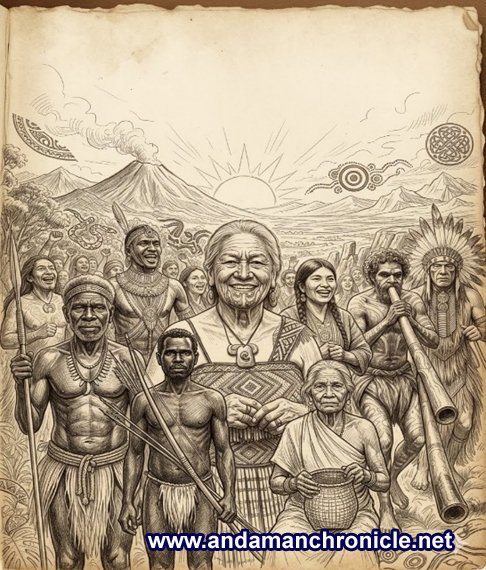
Every year, 9 August is observed as the International Day of the World’s Indigenous Peoples. It is not merely a commemorative occasion but a day on which the world pays tribute to Indigenous Peoples who have safeguarded their languages, cultures, traditions, ways of life, and traditional knowledge for thousands of years.
Indigenous Peoples are not simply communities identified by their ancestry. They are the custodians of some of humanity’s oldest cultural traditions and ways of living in harmony with nature. Despite rapid modernization and globalization, they have preserved their unique identities and cultural heritage, making them an enduring symbol of resilience and continuity.
The Andaman and Nicobar Islands are home to some of the world’s most unique Indigenous communities. The Jarawa, Onge, Great Andamanese, Sentinelese, Shompen, and Nicobarese each possess their own distinct language, culture, customs, and way of life. This extraordinary cultural diversity is one of the greatest treasures of the islands.
Nature occupies a central place in the lives of Indigenous Peoples. Forests, seas, land, animals, and birds are not viewed merely as resources but as an integral part of life itself. They use natural resources responsibly, taking only what they need and maintaining a balance with the environment. At a time when the world faces climate change, environmental degradation, and biodiversity loss, their sustainable way of life offers valuable lessons for humanity.
Their traditional knowledge is equally invaluable. Their understanding of medicinal plants, ecological systems, seasonal changes, food gathering practices, community cooperation, and respect for nature has been passed down orally from one generation to the next. This knowledge is not confined to books it continues to grow well in their daily lives.
In today’s rapidly globalizing world, many Indigenous languages and cultures are at risk of disappearing. When a language is lost, a community’s history, knowledge, traditions, and unique worldview are also lost. Therefore, protecting the rights, languages, and cultural heritage of Indigenous Peoples is a shared responsibility of all humanity.
Students, in particular, should learn about Indigenous communities. They are not only an important part of history but also living examples of environmental stewardship, sustainable resource use, social harmony, and respect for cultural heritage. Their way of life reminds us that true development is achieved not by leaving nature and tradition, but by progressing while protecting and respecting them.
World Indigenous Peoples’ Day reminds us of our collective responsibility. It is not a day to simply observe Indigenous communities from a distance, but an opportunity to respect their rights, preserve their cultures, learn from their wisdom, and ensure that this invaluable human heritage is passed on to future generations.
Let us protect the cultural heritage of Indigenous Peoples, respect their traditional knowledge, and celebrate the living heritage of humanity.
Muthu Pandi, Freelance Anthropologist (muthuboss90@gmail.com)