
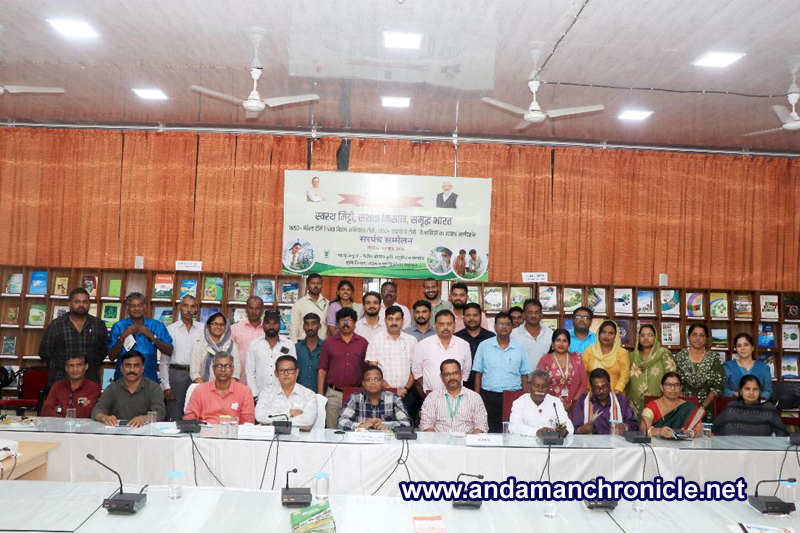
Sri Vijaya Puram, June 9: As part of the nationwide “Khet Bachao Abhiyan”, the ICAR-Central Island Agricultural Research Institute (ICAR-CIARI), Sri Vijaya Puram, organized a Sarpanch Sammelan and Consultation Meeting on Balanced Use of Fertilizers on 9 June 2026. The programme brought together scientists, officials from the Department of Agriculture, Central Integrated Pest Management Centre (CIPMC), Krishi Vigyan Kendras (KVKs), Sarpanches, Panchayati Raj Institution (PRI) members from eight Panchayats of South Andaman, and progressive farmers to discuss sustainable agricultural practices and soil health management in the Andaman and Nicobar Islands.
Welcoming the participants, Dr. Y. Ramakrishna, Principal Scientist & Head, emphasized the importance of coordinated efforts among all stakeholders for promoting balanced nutrient management and sustainable farming systems across the Islands.
Addressing the gathering, Shri. Debabrata Basantia, Director of Agriculture, A&N Administration, highlighted the objectives of the Khet Bachao Abhiyan and stressed the need to conserve soil health. He cautioned that excessive use of chemical fertilizers and pesticides leads to soil degradation, loss of fertility, and environmental damage. He urged farmers to undertake periodic soil testing and encouraged the promotion of organic and natural farming practices at the village level.
During the interaction, Shri. Debabrata Basantia, Director of Agriculture, A&N Administration, apprised the participants of the various subsidy schemes available for the purchase of tractors, power tillers, and other agricultural implements. He encouraged farmers to remain in regular contact with their respective zonal agriculture offices to stay informed about the latest schemes and avail themselves of the benefits provided by the Department. Shri. Basantia also reiterated the Department’s commitment to ensuring the timely availability of quality seeds and planting materials to farmers. Addressing the issue of organic certification, he stated that efforts would be undertaken to facilitate linkages with recognized certification agencies and explore suitable mechanisms to support farmers in obtaining certification and accessing better market opportunities for their produce. Responding to the issues raised, Shri. Basantia informed farmers about the various government subsidy schemes available for the purchase of tractors and agricultural machinery. He advised them to regularly interact with the Agriculture Department’s zonal offices to stay updated on schemes, input availability, and support services.
Addressing farmers’ concerns regarding papaya mealybug infestation, Dr. M. Ranjit, Assistant Plant Protection Officer, CIPMC, recommended an integrated pest management (IPM) approach for sustainable control of the pest. He emphasized the importance of field sanitation and the removal of alternate host plants to reduce pest build-up. He further advised the release of the parasitoid Acerophagus papayae @ 100 numbers per acre, which has proven highly effective in the biological control of papaya mealybug. Farmers were also advised to apply fish oil rosin soap @ 25 g/litre of water, neem oil at 2%, or neem seed kernel extract (NSKE) at 5% as eco-friendly management options. In addition, he stressed the conservation of beneficial natural enemies such as coccinellid beetles and lycaenid insects, which play an important role in suppressing mealybug populations under field conditions.
Dr. Jai Sunder urged farmers to adopt organic and natural farming practices and advised the Department of Agriculture to assess the demand for seeds and planting materials well in advance to ensure timely availability to farmers. He also emphasized reducing the use of plastics, noting that plastic pollution and microplastics pose serious threats to soil, water, and human health. He encouraged farmers to participate in training programmes organized by KVKs and ATMA to remain updated on emerging agricultural technologies. Further, he advocated the identification and promotion of local entrepreneurs and progressive farmers for block-level seed production and strengthening self-sufficiency in quality seed supply. He also stressed the need to establish vermicompost production units at the block level to support sustainable nutrient management and reduce dependence on chemical fertilizers.
The programme concluded with a formal vote of thanks proposed by Shri Mohit, Subject Matter Specialist, who expressed gratitude to all participants and stakeholders for their active involvement in making the event successful.