
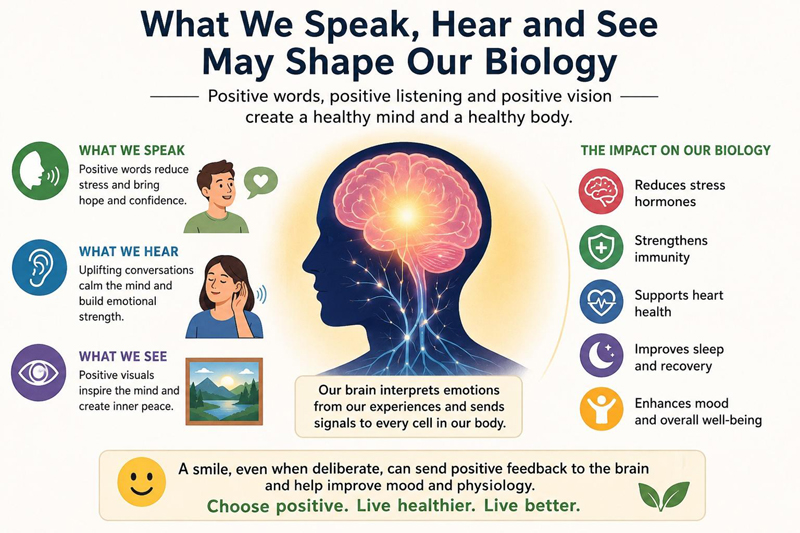
Sri Vijaya Puram, July 8: The words people speak, the conversations they hear, and even the images they repeatedly watch may have a profound influence on human biology, according to renowned scientist and Padma Shri awardee Dr. Ajai Kumar Sonkar, who says that the brain is continuously interpreting emotional signals from its surroundings and translating them into biological responses.
Presenting what he describes as an emerging perspective at the crossroads of neuroscience, psychology and epigenetics, he says the human body is influenced not only by nutrition, exercise and genetics, but also by the emotional environment created through speech, thoughts, sounds and visual experiences.
“The brain is listening every moment,” he says. “Every word we repeatedly speak, every conversation we repeatedly hear and every image we repeatedly see becomes part of our internal environment. Over time, our biology begins to respond to that environment.”
According to the scientist, modern neuroscience has shown that the brain possesses remarkable neuroplasticity. Repeated experiences strengthen particular neural pathways. Exposure to hope, gratitude, compassion and meaningful relationships reinforces networks associated with emotional resilience, whereas repeated exposure to fear, hostility, conflict and pessimism repeatedly activates stress pathways, increasing the production of stress hormones that can influence immunity, sleep, cardiovascular health and mental well-being.
He says the brain often responds more to the emotional meaning and repeated experience of information than to whether it is objectively true or false. “If a person repeatedly lives in an atmosphere of fear, hopelessness or conflict, the brain gradually treats that environment as normal. Similarly, when the mind is repeatedly exposed to optimism, encouragement and kindness, it begins to build healthier emotional and biological responses.”
Explaining this principle further, he points to one of the most familiar human expressions, a smile.
“A smile is not merely an expression of happiness; it can also become a cause of happiness,” he observes. “Scientific studies suggest that even a deliberate or posed smile can send positive feedback to the brain through facial muscles. One does not always have to wait to feel happy before smiling. Sometimes the act of smiling itself helps initiate positive changes in mood and physiology.”
He believes the same principle applies to speech and listening. “Positive words, even when spoken consciously as a habit, may gradually influence our mental state. Likewise, repeatedly listening to encouraging conversations and surrounding ourselves with constructive ideas can create a healthier internal biological environment.”
Referring to the placebo and nocebo effects, he says modern medicine has already demonstrated that expectations can influence biological responses. Positive expectations may improve health outcomes, while persistent negative expectations can produce genuine physical symptoms, illustrating the close relationship between the brain and the body.
Drawing attention to the medical profession, he notes that physicians spend much of their professional lives dealing with illness, suffering and death while working under enormous psychological pressure. Numerous scientific studies have documented high levels of burnout, depression, sleep disorders and chronic stress among healthcare professionals, with some research suggesting reduced life expectancy in certain physician groups. He emphasizes that these findings are attributed primarily to prolonged occupational stress and emotional burden rather than merely discussing diseases.
“The example reminds us that our biology continuously reflects the emotional climate in which we live,” he says. “Chronic exposure to stress leaves measurable effects on the brain, hormones and immune system.”
The scientist also expresses concern over today’s digital lifestyle. Endless exposure to disturbing news, hostile debates, violent entertainment and emotionally charged social media content may keep the brain in a prolonged state of alertness.
“Our nervous system evolved to respond to occasional danger, not to a continuous stream of negativity,” he says. “When alarming information becomes our daily mental diet, the body’s stress response may gradually become chronic.”
However, he cautions against avoiding reality or ignoring genuine problems. Instead, he advocates consciously balancing life’s inevitable challenges with experiences that promote psychological restoration and emotional well-being.
He recommends cultivating simple daily habits such as speaking kindly, practicing gratitude, smiling more often, engaging in mindfulness and meditation, spending time in nature, reading inspiring literature, listening to uplifting music and nurturing meaningful relationships. These practices, he says, create an internal environment that supports healthier biological functioning.
“Our biology is constantly listening,” he concludes. “Every positive word we repeatedly speak, every hopeful conversation we choose to hear, every smile we consciously offer and every uplifting experience we embrace becomes a biological message to the brain. Through the brain, every organ in the body receives those signals. Therefore, creating a positive emotional environment is not merely a philosophy of life, it may be one of the simplest and most powerful investments we can make in our long-term health.”
He believes that future biomedical research will increasingly explore how language, emotions, neurobiology and epigenetic regulation interact, potentially opening new frontiers in preventive medicine, mental health and human well-being.